
Acceleration - Chapter 4
The city runs. Not everything holds.

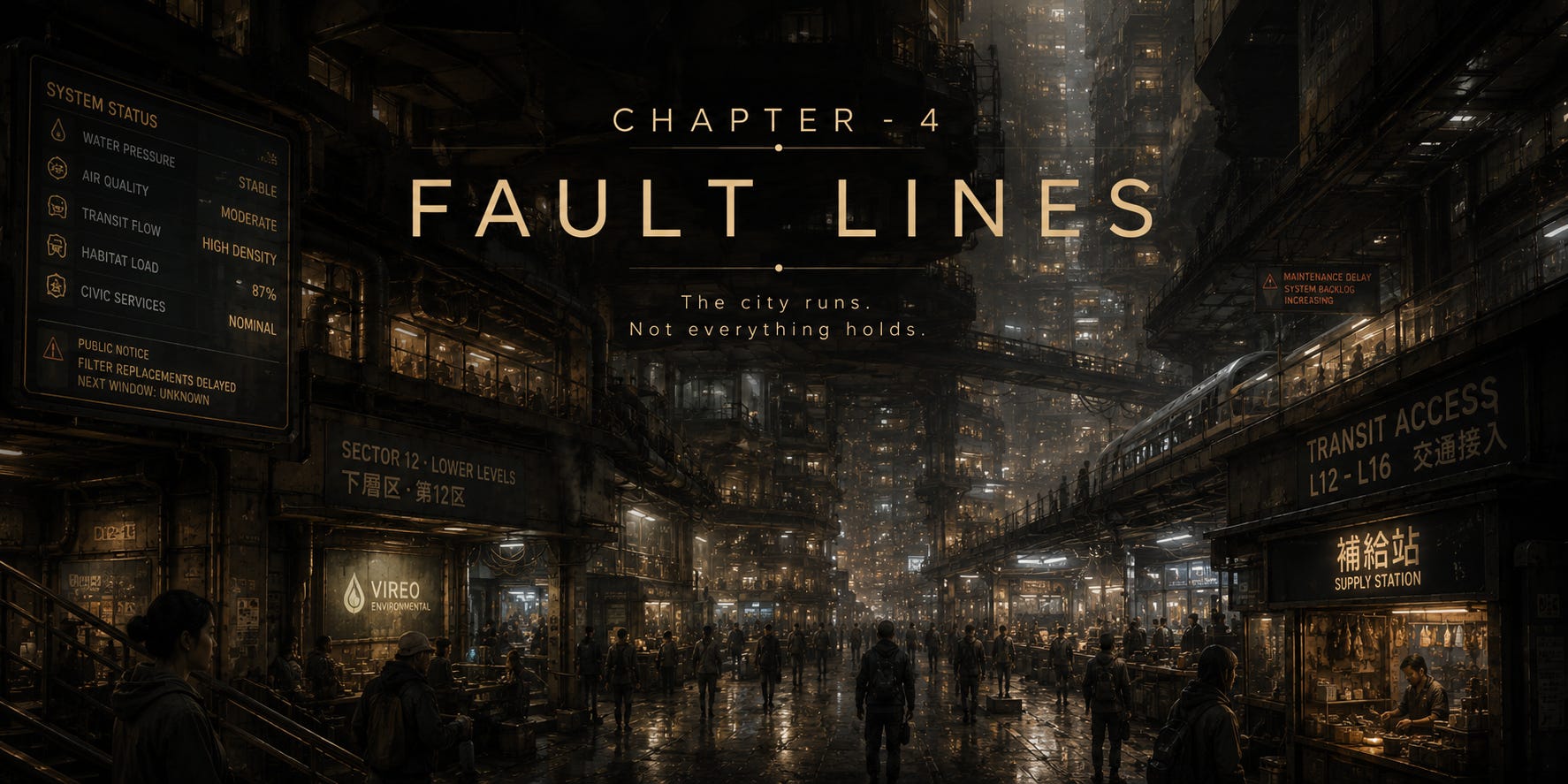
Chapter 4 – Fault Lines
Wednesday, July 12th, 2045
Angelas Megacity – The Lower Levels
Angelas Federal Bloc
Lila Moreno woke before the light changed.
She did not need to be awake at that exact moment. Nothing required it. But the lower levels had trained her that way over time, quietly and without asking permission. You learned to surface before the systems shifted, to meet the day before it arrived, because once it did, it moved whether you were ready or not.
There was no sunrise here. No slow negotiation between dark and light. The ceiling panels above her apartment didn’t imitate the sky or pretend at softness. They simply changed state. At precisely 0600 the color would slide from a dull, amber haze into a sharper, cooler white, as if someone somewhere had decided that morning had begun and the rest of the city would follow.
She was already upright when it happened. She didn’t look up. She listened. That came first now, the same quiet inventory before movement. She listened to the pipes behind the walls, recycled water moving through narrow arteries that never quite stopped murmuring; to the filtration ducts pulling stale air out and pushing something marginally better back in; to the deeper vibration of transit lines above her level, unseen but always present. Like a second heartbeat layered over the first.
The city never slept. That was something people said about the upper tiers, like it was a sign of vitality, of energy, of life at scale.
Down here, it wasn’t life. It was process. A constant, mechanical, indifferent process.
You learned the patterns because you had to. Which hum belonged to which system. Which vibration meant normal load. Which slight shift in tone meant something upstream had changed. Not enough to trigger alarms, and not enough to matter to anyone who wasn’t living inside it, but enough that your body noticed before your mind did.
This morning held steady – no irregular cadence. No pressure fluctuation in the pipes. No delayed transit-cycle echo moving through the structures.
That should have felt reassuring. Instead, it pressed lightly at the back of her awareness, the way a perfectly still room sometimes did, like the absence of noise had become its own kind of signal.
She exhaled slowly and let the breath settle before moving.
Her apartment was small in a way that didn’t invite complaint. There was no alternative to compare it to. It was one room divided by habit more than walls: bed, basin, storage, a countertop near the door. Every object had a place; there wasn’t space for anything that didn’t.
The apartment’s wall display tracked the room in quiet categories: water allowance, filter status, thermal efficiency, sleep-cycle compliance. None of it required her attention unless something drifted close to its threshold. That was the kindness of it, or the insult, depending on the morning. The room knew what she used, what she saved, what she delayed replacing. It never judged. It simply recorded.
A faded Vireo Environmental stamp glowed in the corner of the apartment display, the pale green droplet almost washed out from years of use.
It was orderly in the way lower-level rooms had to be: maintained, not curated. Down here, cleanliness was earned in increments.
She kept the room clean because letting it go meant something else had gone first, it was earned in increments: wiped surfaces, filters replaced when she could get them, dust cleared by hand. Expectation had nothing to do with it.
She swung her legs over the side of the bed and paused there, feet planted, hands resting lightly on her thighs as her body caught up with the decision to stand. Thirty-three was not old, not in any way she had once imagined age would feel. It did not announce itself in pain or limitation. It announced itself as comparison.
She was old enough to remember when the lower levels had moved less smoothly. Not freely, exactly. They had never been free, but there had been more hesitation in things then. More missed timing. More human pauses inside the city’s rhythm. A person could stop in a corridor without the space around them immediately teaching everyone else how to flow past. Now everything corrected faster.
That was what had changed. Not the city’s cruelty, not its indifference, not even its density. The correction had become cleaner. Quicker. Less negotiable.
She stood without strain, but with attention. That had become the difference.
The basin water came on with steady pressure; she noticed that immediately. There had been a stretch, a few months back, where it fluctuated just enough to be irritating. Not failing, never failing, but inconsistent in a way that forced attention. Today it ran clean and even, the stream unbroken as she cupped her hands and brought it to her face.
The water ran cool without ever becoming cold. She washed slowly, letting the routine settle her into the shape of the day. Hair pulled back, secured with practiced movements that didn’t require a mirror. She didn’t rush. There was no advantage to it. The city would move at its own pace regardless of hers. By the time she turned toward the door, she was fully awake.
The display mounted beside it flickered softly as it recognized her presence.
Shift confirmation: active
Transit window: assigned
Access clearance: valid
Green across every field. No flags. No delays. No reassignment.
It all aligned cleanly, exactly as the room promised it would. But something about the alignment felt thinner than it used to. Nothing was wrong. That was almost worse. It felt less forgiving. As if the mesh had not become more precise so much as more exact, less interested in absorbing variation and less willing to tolerate anything that did not fit cleanly inside its expectations.
She watched the display for a moment longer than necessary. She did not expect it to change. She had started to notice that the space between “working” and “holding” was getting smaller, and once you saw that, it was hard to stop seeing it.
She reached for her jacket; she paused with it halfway on and listened again. Just for a second, to the pipes, the air, and the distant movement of the city above her. Everything remained steady, exactly as it should be. But for reasons she couldn’t have explained even if someone had asked, that steadiness no longer felt like a guarantee. It felt like something being maintained.
She stepped into the corridor and the air changed immediately, not dramatically, barely enough for anyone passing through quickly to notice, but enough that her lungs registered the difference before she did. Her apartment held a slower version of the system: filtered air, softened vibration, a little insulation from the corridor’s pace. Out here, it moved faster. The air carried more bodies, more recycled cycles, there was more of the city folded into it.
The hallway lighting had already shifted to full day-state. Door seams along the passage carried small signs of private life: a taped prayer strip, a child’s faded sticker, a coded laundry tag clipped beside a handle, a hand-written note asking maintenance not to reset a water valve before sixth shift. None of it belonged to anything official, but none of it was removed either. The system tolerated small human marks as long as they stayed out of the way.
The light did not soften anything. It simply made everything visible. Clean lines of white illumination ran the length of the passage, uninterrupted except for the occasional maintenance accesses where panels could be removed and replaced when something behind them inevitably required attention.
People were already moving with the steady forward lean the lower levels produced: less rushed, more like already committed to motion. Everyone had somewhere to be and a window to reach it in. No one needed to be told that. The network handled the scheduling. The people handled the compliance, so Lila joined the flow without thinking about it.
That was the other thing you learned down here. Not just the sounds or the patterns of infrastructure, you learned the movement of bodies; how to merge into a corridor stream without breaking it, how to adjust speed by fractions so you didn’t collide, didn’t interrupt, didn’t become the kind of friction the system had already worked so hard to remove. There was a time when movement like this would have felt crowded.
She remembered that, mostly as a sensation of the subtle resistance of space when too many people occupied it at once. The unpredictable stops and starts, someone hesitating or someone turning unexpectedly. The small, human inefficiencies that made shared space feel alive.
That had belonged to an earlier city.
Before the pacing guides, or before the subtle directional cues embedded into the lighting strips along the floor. Before the soft, almost imperceptible audio pulses that encouraged forward motion at just the right cadence to keep throughput smooth.
Now the corridor moved as one continuous, regulated flow of humanity: no stops, no surges, no room for a person to become an interruption.
It was efficient now, and predictable, and also quietly enforced. A man ahead of her adjusted his stride slightly to accommodate someone merging from a side alley. It happened cleanly, without contact and without hesitation. The network absorbed the deviation before it fully formed.
Lila watched it happen and felt the echo of something older in the back of her chest. There had been a time when that kind of adjustment carried acknowledgement. A glance, a nod, or even a muttered apology.
A brief, human exchange that existed outside of efficiency. Now it was just – correction. Nothing marked the exchange. No acknowledgement. No glance. No apology. The flow continued, efficient and unbroken.
She passed a maintenance panel that had been opened recently. The seal line wasn’t perfectly flush with the surrounding wall, it was just a fraction off, barely visible unless you knew what you were looking for.
She noticed it because twelve years inside lower-level hospital systems had trained her to read environments the way other people read screens. Not for what was obvious, but for what sat just outside observation.
The panel had been reseated, but not replaced. It was temporary work, done to be within tolerance and not much more, enough to tick a box. She let her fingers brush lightly against the edge as she passed, feeling the slight vibration through the composite surface. Not enough to indicate failure. Not even enough to justify a report on its own.
But it hadn’t always been like that. There was a period, years back, when deviations like this would trigger immediate correction. They had not been dangerous. Back then, the system still had enough capacity to remove imperfection entirely.
Now it allowed small things to sit. It knew they existed, but it had decided they did not matter enough down here.
The alley opened into a wider transit junction, and the density increased without becoming chaotic. That was the trick the city had perfected: same space, more people, same behavior. Layered walkways intersected at controlled angles, guided by overhead indicators that shifted in color and intensity depending on load distribution.
The pacing guides still carried the Meridian Civic Systems mark at intervals: three narrow white bars folding into an arrow. Most people never looked at it. Lila saw it every morning, worn into the floor lighting like ownership pretending to be assistance.
Civic notices moved along mounted display panels above her in narrow bands, never bright enough to pull the eye from the walking path. Hydration reminders. Shift delay advisories. Mental strain resources. Maintenance gratitude prompts thanking residents for patience no one had asked whether they could afford. All of it phrased as assistance, none of it optional enough to ignore completely. The city did not shout down here. It nudged, repeated, corrected, and waited for the body to comply.
A breakfast dispenser folded open along one wall, releasing steam that smelled faintly of soy protein, pepper oil, and recycled heat. The dispenser bore the Kestrel Provisioning mark; a white bird reduced to three hard angles above the intake slot. No menu was displayed. The system already knew what most people would accept.
People collected sealed cups without stopping, wrists flicking past the payment scanner as they moved. The machine never formed a queue; it had been positioned at the precise angle where hunger could be serviced without becoming delay.
Beside it, a repair slot accepted cracked wrist displays, transit clips, filter seals, cheap shoe grips worn smooth by corridor miles. The repair slot carried a chipped PatchLine logo, orange polymer faded almost brown. Below it, a slogan scrolled in small text: KEEP MOVEMENT FUNCTIONAL.
A woman fed a broken wrist latch into the intake and waited while the machine printed a replacement in dull gray polymer. The cost appeared on her personal ledger before the part cooled enough to touch. No one haggled here, haggling required time, and time had already been assigned elsewhere.
Lila slowed slightly as she approached the junction, letting a faster-moving stream of people pass across her path before merging in behind it. The timing was instinctive, she didn’t think about it; her body did.
She remembered when people used to hesitate here, just enough that you had to pay attention. A pause at the edge of a crossing. A moment of decision before stepping into another stream of movement. Now there was no hesitation, the system predicted the merge points before people reached them. It adjusted spacing, modulated flow, it removed the need for decision entirely. It was better. Objectively.
And yet, something in her resisted the word better every time it surfaced, because better at what?
At moving bodies through space?
Yes.
At preserving anything those bodies carried with them?
That was less clear.
A child moved through the junction ahead of her, hand held tightly by an adult who matched the pace of the corridor without looking down. The child’s steps were slightly out of sync, just enough to introduce a faint irregularity into the movement pattern. For a moment, the system compensated.
Spacing adjusted, flow redistributed, and the irregularity was absorbed. Then the adult corrected the child’s pace, tightening their grip, aligning their stride with the rhythm of the people around them and the transit rhythm returned to perfect continuity.
Lila felt that, more than she saw it. The correction, not the mechanical one, the human one.
She reached the transit platform just as her assigned window opened. There was no waiting, there was rarely waiting anymore. The platform doors parted with precise timing, aligning with the incoming carriage before it had fully settled into place. The interior lighting matched the corridor exactly, no shift in tone, no disruption in visual continuity. You stepped from one system into another without noticing the boundary.
The missing boundary was the design.
She boarded with the rest of the flow and found her position without searching. There were no seats in this carriage, not at this level, not at this time of day. Standing capacity optimized throughput. There were handholds positioned at uniform intervals, height-adjusted for average reach. Everything was measured and everything was perfectly placed.
The doors sealed behind her and the carriage began to move. Acceleration was smooth enough that you didn’t feel it unless you were looking for it. Lila always looked for it, and there it was, just a fraction of a second where inertia lagged behind motion. A subtle pull through her shoulders, a shift in weight through her feet.
She closed her eyes for a moment as the carriage slid into the vertical network, rising through layers of the city she would never fully see but always felt.
And underneath the movement, underneath the systems and the precision and the endless quiet correction of deviation, something else remained.
A memory, not of how the city looked, but of how it used to feel.
Less exact, less certain, but more… forgiving.
When she opened her eyes again, the carriage had already passed into a higher transit band. The air was cleaner, but not by much. They were technically still within the lower levels, just higher. But it was just enough cleaner that someone who hadn’t lived their entire life measuring differences like this wouldn’t have noticed at all. Lila noticed because noticing had become part of the work.
The carriage decelerated without announcement; there was no audible cue and no visible indicator beyond the subtle shift in weight distribution across the bodies standing around her. The network assumed awareness, it assumed compliance. It assumed that everyone inside it understood the rhythm well enough not to need to be told what was happening next.
Lila felt the change before the doors opened, as a fractional easing through her knees. The pressure through her feet redistributing as the carriage aligned with the platform. The kind of movement you stopped noticing if you trusted the system completely.
She never stopped noticing.
The doors parted and the air changed again. It was cleaner here. Not in a way that felt fresh, not like outside air, or anything that belonged to a natural environment, but like it was processed differently. It was. It had been filtered through a higher-grade cycle. Less particulate. Less density. The underlying scent of the lowest levels was still there, but it had been reduced, almost flattened, as if it had been passed through something that removed its edges without removing it entirely.
She stepped forward with the others and crossed the threshold. There it was. It wasn’t visible. It hadn’t been announced. But she knew it was present.
The divide was not a wall, a gate, or a checkpoint. That would have made it easier to name. This was a gradient: a shift in how much attention the system was willing to spend on you.
The platform here was wider, not dramatically, but enough that people didn’t have to stand shoulder-to-shoulder while waiting for the next movement cycle. The lighting was softer, still precise though. It wasn’t dimmer either, just less harsh at the edges, like someone had tuned it for comfort rather than visibility alone.
There were seats here too, not many, just enough to suggest that waiting was acceptable in this layer of the city. Lila registered that without slowing. She had time, technically, her shift window accounted for this segment of transit. She could have sat and taken a minute before continuing up into the hospital level. She didn’t, habit didn’t allow it.
The people here moved differently. They were still aligned with the system. Still predictable. Still efficient, but less compressed. There was space between them now, it wasn’t much, but enough that individual movement started to re-emerge. Someone adjusted their bag without disrupting the flow. Someone slowed slightly to check a display without forcing three others to compensate around them. The system allowed it here. That was the visible difference.
She moved toward the vertical transfer corridor, following the soft directional cues embedded in the floor lighting. They didn’t tell you where to go, they suggested it. With just a subtle shift in color, a gradient of light that pulled movement toward optimal pathways without ever declaring itself as instruction. Most people followed it without realizing they were doing it. Lila followed it because she understood what happened if you didn’t.
The lift banks here were quieter. Not silent, because nothing in the city was ever truly silent. But the mechanical undercurrent was reduced, like it was dampened behind better insulation, better materials and better maintenance cycles. It was.
She stepped into an open lift carriage as it aligned with the platform, the transition seamless enough that it barely registered as movement from one system into another. Inside, the space was larger than the transit car below, not significantly, but enough to notice if you spent enough time down there. Lila did.
There were seats here too. Today, half were occupied. The rest sat open without urgency, so Lila took one. She didn’t need to, but she noticed she could, so she did.
The doors sealed and the lift began its ascent, vertical movement always felt different. It always had. Horizontal transit carried you through the city while vertical movement repositioned you inside it.
She felt it in her stomach, in the subtle reorientation of her body as the lift rose through layers that were physically close but functionally distant. A woman across from her glanced down at a handheld display, scrolling through something slowly, without tension. There was no urgency in the movement, and no compression in her posture.
Lila watched her for a moment, not at the device, but at the way she held it. Loose and unforced. That used to be everywhere. Not the devices or the technology.
The way people occupied their time inside it.
There had been room for that once, small pockets of time where nothing was required of you immediately; where the system didn’t need your constant alignment to maintain its own. Those pockets were gone in the lower levels; they had been compressed out. They had been reallocated into throughput, optimization and productivity.
The lift slowed as it approached the hospital tier. Lila felt the deceleration before the indicator strip along the door shifted color to signal arrival. Her hand moved instinctively to the edge of the seat as the carriage settled into its rhythm. There was always that slight lag, that tiny space where the body remembered movement even after the system had already corrected it. The doors opened, and the hospital greeted her the same way it always did.
Clean enough to feel impersonal. Ordered enough to pass for calm.
Intake bands glowed along the floor in muted colors, each one corresponding to a patient pathway most people never learned to read. Sanitation drones moved beneath wall recesses, quiet enough to be mistaken for ventilation. Privacy screens rested half-open between bays, translucent rather than opaque, preserving dignity without interfering with visibility. Above each bay, a small status glyph hovered in the local overlay, visible to staff and invisible to patients without the optical overlays. Green meant stable. Blue meant deferred. Amber meant watch. Red almost never appeared here anymore. Red meant the system had been surprised.
The air here was different again, sterilized, but not aggressively so. It was balanced and controlled within tighter parameters than the transit systems below. The temperature was regulated to a narrow band that removed discomfort without ever feeling warm. The floors carried a muted sheen, smooth enough that movement across them produced almost no sound. Even footsteps were absorbed.
This was where the system showed its best face, where efficiency could still pass convincingly as care. Where everything that made the lower levels feel compressed and mechanical was reframed as precision and reliability. Here, it worked, and it worked well.
Lila stood at the threshold for a moment longer than necessary, just long enough for the difference to settle fully into place. She had done it for years. That was enough to make it a ritual.
Down there, the system’s allocation logic moved people. Up here, it preserved them. At least, that was the story it told.
She stepped forward and the doors closed behind her, sealing the transition as cleanly as every other network boundary in the city. There was no acknowledgment that anything had changed, but it had, she could feel it.
The same way she felt the pipes in the walls that morning, the same way she felt the timing of the transit lines and the same way she had started to feel that something small, subtle, almost invisible, was tightening across all of it.
And up here, it hadn’t reached the surface yet.
The intake corridor was already active, but it wasn’t crowded. It was never crowded anymore. Crowded. That word didn’t apply here anymore, everything was distributed, spaced, and timed to prevent accumulation before it formed. Patients moved through in measured intervals; each arrival was absorbed into the system before the next one entered its orbit. There were no queues, no waiting rooms filled with bodies, only continuous patient flow.
Lila passed through the access threshold and the system recognized her immediately. It gave her a soft tone; it was barely audible. Her presence was registered; her clearance was verified and her position in the shift map confirmed without requiring her to stop or present anything physical.
Inside the hospital, the rhythm changed again. The medical staff moved with purpose, but without urgency. That was the standard now. Urgency implied unpredictability, it implied something had fallen outside expected parameters. But here, everything operated inside those parameters. Even the unexpected had a pathway to follow.
The overhead displays carried the Synapse Health Logistics mark in the lower corner, a medical cross broken into connected nodes. Care, translated into flow and volume.
Each clinician wore a soft-interface cuff at the wrist, pale bands that pulsed only when a task entered their immediate radius. They did not command, not officially. They sequenced, they reminded, they narrowed attention until the next correct action felt like the only one available. The cuffs were Orison MedSystems issue, pale blue rings pulsing beneath translucent polymer. The logo was almost invisible unless the light caught it: a circle with one deliberate gap, as if even care required an access point.
Lila moved toward her station, her steps aligning automatically with the internal flow of the floor. She didn’t need to check her assignment; she already knew where she would be needed. She always did.
Bed allocation grid: stable
Triage load: within tolerance
Staff distribution: optimized
The overhead displays updated continuously in constant, incremental corrections. Numbers adjusting by fractions. Colors shifting by degrees. Nothing was static and nothing was left to drift. It looked controlled, because it was controlled.
And yet, she slowed as she passed the third intake bay, not enough to interrupt movement or get in the way, just enough to see.
The patient was older, worn in a way that didn’t map cleanly to just age. Their skin carried the texture of long-term exposure to something that never fully left the body. Their hands were marked with fine tremors that weren’t severe enough to flag immediate intervention, but persistent enough that they wouldn’t resolve on their own.
The mesh had already categorized him.
Non-critical.
Deferred intervention.
Stabilize and cycle.
A clinician stood beside him, their posture perfect and movements precise. The interaction was efficient. Questions were asked in the correct sequence. The responses were logged before they fully left the patient’s mouth. There was no delay here, and no wasted motion.
The cognitive overlay carried an Aegis Behavioral Safety tag, low priority, no escalation. A gray shield, a central point, and the calm certainty of something designed to notice only what it had been taught to see.
Lila watched the exchange for a moment longer than she needed to, the old man answered everything clearly and coherently, but he did hesitate, just once. It was a fraction of a second between one question and the next. The system didn’t register the delay because it had no reason to.
The delay fell well within acceptable tolerance bands, and it didn’t disrupt the intake sequence, or slow throughput. It didn’t affect the outcome classification at all. So it passed, unmarked and unregistered. Lila felt it though, that hesitation. Not as data, as weight. She moved on as her station came into view, already active.
A young woman lay on the bed, her eyes open, tracking the ceiling rather than the staff moving around her. Monitoring lines were attached cleanly, and her vitals were stable. The readouts confirmed what the system had already determined.
Low priority.
Manageable.
Contained.
A transit badge still hung from her jacket, the corner cracked, the surface rubbed cloudy from years of use. Beneath her left temple, just above the jawline, Lila noticed the faint raised seam of a sensory bridge. Not old work. Not local either, unless someone had gone to considerable effort to make it look like something it wasn’t.
The overlay tagged the device before Lila touched the chart.
DEVICE HANDSHAKE: PRESENT
FIRMWARE STATE: UPDATED
LEDGER AUTHENTICATION: INCOMPLETE
CLINICAL RISK: LOW
That combination made her slow.
Updated and incomplete did not belong together. Not in medical architecture. A device either authenticated its update or it didn’t. The system should have rejected the contradiction before assigning risk.
Instead, it had categorized the conflict as non-critical because the body attached to it was not failing.
“Lila.”
The voice came from her right, calm and even.
She turned.
“Morning.”
Her colleague gave a brief nod, already halfway through the next task as the acknowledgment completed. There was no pause for conversation, no space allocated for it inside the workflow. There used to be.
Years ago, someone would have asked about sleep. About family. About whether the last patient had stayed with you longer than it should have. Those questions had never been part of the official work, which was why they had mattered.
“Room three flagged?” Lila asked, without looking away from the patient.
“Within tolerance.” The answer came immediately, as if the phrase had been waiting for a mouth.
As Lila stepped closer to the bed, the young woman’s gaze shifted, not toward her, but just past her, like she was tracking movement that didn’t quite exist in the space.
“Can you hear me?” Lila asked.
Several heartbeats passed.
“Yes.”
The response was clear. There was no confusion or distress in the tone, and her vitals agreed. But the woman did not look at her.
COGNITIVE MARKER: ACCEPTABLE
SYSTEM CLASSIFICATION: UNCHANGED
Lila studied her for a moment. There was nothing overtly wrong. Nothing she could see that would trigger escalation or justify intervention beyond what had already been assigned.
“How long has it been like this?” Lila asked, quieter now.
There was another pause before the woman replied, longer this time.
“I don’t know,” the woman said. “Since the patch.”
Lila looked back at the overlay.
“Patch?”
The woman blinked, slow and unfocused. “It said the update failed.”
The mesh logged the response and categorized it under patient-reported device confusion.
“But it didn’t fail,” the woman said. Her eyes moved again, following something above Lila’s shoulder. “That’s the problem.”
Lila reached out and adjusted one of the monitoring leads. It did not need correction. It gave her a reason to remain there for a few seconds longer.
The contact was brief, professional, and within protocol. But the woman’s eyes tracked her hand and held there for just a moment longer than necessary. That had not been happening before.
“Try to rest,” Lila said.
The words felt automatic, like a system-compatible script.
The woman blinked once.
“It doesn’t quiet,” she said.
There was still no change in her vitals, still no escalation trigger or flag. But Lila straightened at that. The mesh had heard the words, but it had not understood them.
She moved back to her station in the hallway and brought up the patient log for the woman, the entries aligned perfectly. There were no anomalies in them, and she found no deviations from protocol. There was no indication that anything inside the system required adjustment.
And yet, she could feel it again now, the same thing she’d felt in the corridor, in transit, and in the pipes behind her walls that morning. It did not feel like failure. It felt like pressure. Something building inside a system that was still, technically, working.
Her shift continued without interruption. Lila moved through the floor in measured increments, her presence threading between tasks rather than stopping inside them. Adjustments where needed. Confirmations where expected. Hands moving with the same quiet precision the system demanded of everything inside it.
Nothing stalled, nothing asked for more than it had been allocated, until room seven.
She wouldn’t have stopped if she hadn’t already been carrying it, the first one, the woman from earlier and the hesitation. The way the woman’s eyes had tracked something that wasn’t there.
This one was different, male, younger, mid-thirties, maybe, vitals were stable, he was in post-incident intake, he had been flagged and cleared within the standard response windows. He was sitting upright when she entered, elbows resting lightly on his knees, hands hanging loosely between them. He was completely still; the only movement was the slight rise and fall of his chest as he breathed.
He didn’t even look at her when she entered.
“Can you hear me?” she asked.
His head tilted slightly at the sound of her voice, not toward her, but as if he was looking past her.
“Yes,” he said. His tone was flat, clear, unrestrained.
Lila stepped closer.
“Do you know where you are?”
There was only a brief pause before he responded, but he still did not look at her.
“Hospital,” he said.
He had answered that correctly, which was an immediate classification reinforcement.
She watched his eyes. They didn’t settle as they moved in small, consistent adjustments, like he was tracking something just beyond the edges of the room.
“Are you in pain?” she asked gently.
“No.”
His vitals confirmed it; there were no spikes in any of the readings.
“Can you describe what you’re experiencing?”
He paused again before responding. The same way as before, only longer this time. He frowned slightly, not in confusion, but in concentration. Like he was trying to translate something that didn’t fit cleanly into words. He still had not looked at Lila.
“It’s… layered,” he said finally.
The mesh logged the response, categorizing with a cluster of other reports.
Lila checked the device field before the mesh collapsed it back into summary. Same contradiction. Different body.
DEVICE HANDSHAKE: PRESENT
FIRMWARE STATE: UPDATED
LEDGER AUTHENTICATION: INCOMPLETE
CLINICAL RISK: LOW
But this time there was an additional line of data:
ARCHITECTURE: UNREGISTERED
Lila didn’t move now. “Layered how?”
He inhaled slowly and held the breath.
“It’s like… there’s something running under everything,” he said. “Not loud. Just...” He hesitated, searching. “Constant.”
Lila felt her shoulders tighten. She didn’t show it visibly, not enough for anyone to see.
“Does it stop?” she asked.
He shook his head once. A small movement, but definite.
“No.”
As soon as the words left his lips, he started to bounce his knee. It wasn’t a big movement, but it was fast and constant, like a fidgeting child with too much energy.
Behind her, the system updated again. There was a soft shift in the overhead display. Another intake window had opened, and another patient was already moving into place.
The clinician assigned to the room stepped forward, picking up the interaction seamlessly.
“Cognitive markers remain within acceptable range,” they said, almost as a reassurance to the space itself.
Of course they did. Lila stepped back. She was not done, there was simply nothing in the protocol that allowed her to stay. He was not her patient and from the system’s perspective everything was holding.
She exited the room and the door sealed behind her without a sound. Two was not a pattern, not yet, but it was close enough that her body had already started to treat it like one.
The hospital floor carried on around her as Lila moved back toward the main nurses station, but her attention shifted outward now, pulling in fragments she might have ignored before. Conversations not meant to be overheard. Network chatter filtered down into human voices.
“…came in from lower corridor access. No registration trail.”
“…that’s the third this week.”
“…they’re not flagging it because vitals hold.”
“…doesn’t matter where it’s coming from if it’s non-critical.”
She didn’t look toward the speakers. She didn’t break her pace.
“…heard it’s coming through black routes.”
“…what, like mods?”
“…not licensed.”
“…firmware patches, mostly.”
“…from inside the bloc?”
There was a pause.
“…doesn’t look like it.”
That made her slow, just slightly.
“…China?”
“…maybe. Or something built off Chinese architecture.”
“…I thought those were still compatible.”
“…official ones are.”
“…and these?”
“…these aren’t official.”
The words settled across the floor without changing anything. No alert opened. No inquiry field expanded. No system prompt asked whether staff had overheard an emerging risk condition. The conversation dissolved back into movement as she continued walking, into task, into compliance.
China was still visible on the maps. Still present in trade summaries. Still active in medical imports, firmware exchanges, and clinical compatibility ledgers where the documentation remained useful enough to pass.
But it had begun to move differently.
Not outside the system, not yet. Just less legibly inside it. Revised access protocols, sovereign data partitions, device architectures that reported status cleanly while refusing to show enough of themselves to be understood. If something came through from that edge of the mesh, the hospital would not necessarily know how to name it.
And if it could not name it, it would keep treating the thing as noise until a body made it impossible.
Lila reached the main station and stood there for a moment, not interacting with the display, she just let the floor continue around her. The words didn’t belong to one patient anymore, they sat across both of them, aligned and still within tolerance.
Her shift ended the way it began, cleanly and without friction. There was no patient backlog and no unresolved cases requiring carryover with the next shift. There was no indication, anywhere in the mesh, that anything had occurred outside expected parameters.
Shift complete: confirmed
Transit window: assigned
Exit clearance: valid
Green across every field.
She stood there for a moment before stepping away from the terminal. Something in her resisted the clean closure of it. But nothing had really crossed the threshold that required attention, and yet there had been two.
She turned and moved toward the exit and the hospital released her as seamlessly as it had received her. The doors opened ahead of her movement, and the lighting guided her path.
She did not pause and there were no interruptions as she made her way back to the vertical junction. The lift carried her back through the same vertical distance, but it felt different now. Not physically, internally. She stood this time, not taking a seat, and the people around her shifted subtly as the carriage descended.
Their postures tightened. Their movement compressed again as they approached the lower bands. And the system adjusted its expectations.
She felt it in her chest before she saw it in them.
The doors opened, and the air thickened around her, as the corridor accepted her without acknowledgment and folded her back into the stream of people.
This time, though, she noticed the pacing cues more, and the subtle pull of light. She felt the pressure of movement behind her and the expectation of alignment. She matched it because the corridor expected her to, but she felt the edges of it now. She felt where it pressed, and where it narrowed.
Layered. The word stayed with her all the way back to her door.
The apartment was the same when she finally entered, exactly the same. It should have been comforting. Not today. She closed the door behind her and stood still for a moment, listening. To the pipes, the air movement and the distant hum of transit. All of it was holding. All of it normal again, exactly as it should be.
Except now there was a slight ringing in her ears, faint as tinnitus. She knew it was coming from her own cochlea, but for a fraction of a moment she was not fully sure it wasn’t coming from somewhere outside the room.
She moved through her routine without thinking. Jacket off. Hands and face washed. The water pressure was still steady, and she appreciated that.
She sat down on the edge of the bed for a moment, letting the day fall away from her as best as she could. She was in the same place she had been that morning, even holding the same posture, but the room had changed because she had. Those two patients kept running through her mind. Different words. Same feeling underneath. Layered. Doesn’t stop.
She exhaled slowly and leaned forward, forearms resting on her thighs as she thought about it. The mesh hadn’t flagged it, hadn’t recognized it, hadn’t even registered that anything was there to be seen.
Which meant it wasn’t part of the model.
And if it wasn’t part of the model, it would keep passing unmarked and uncounted.
She sat there for a long time, not trying to solve it. Not yet.
Just holding it, like pressure.