
Acceleration - Chapter 5
They design the order. The world obeys it.

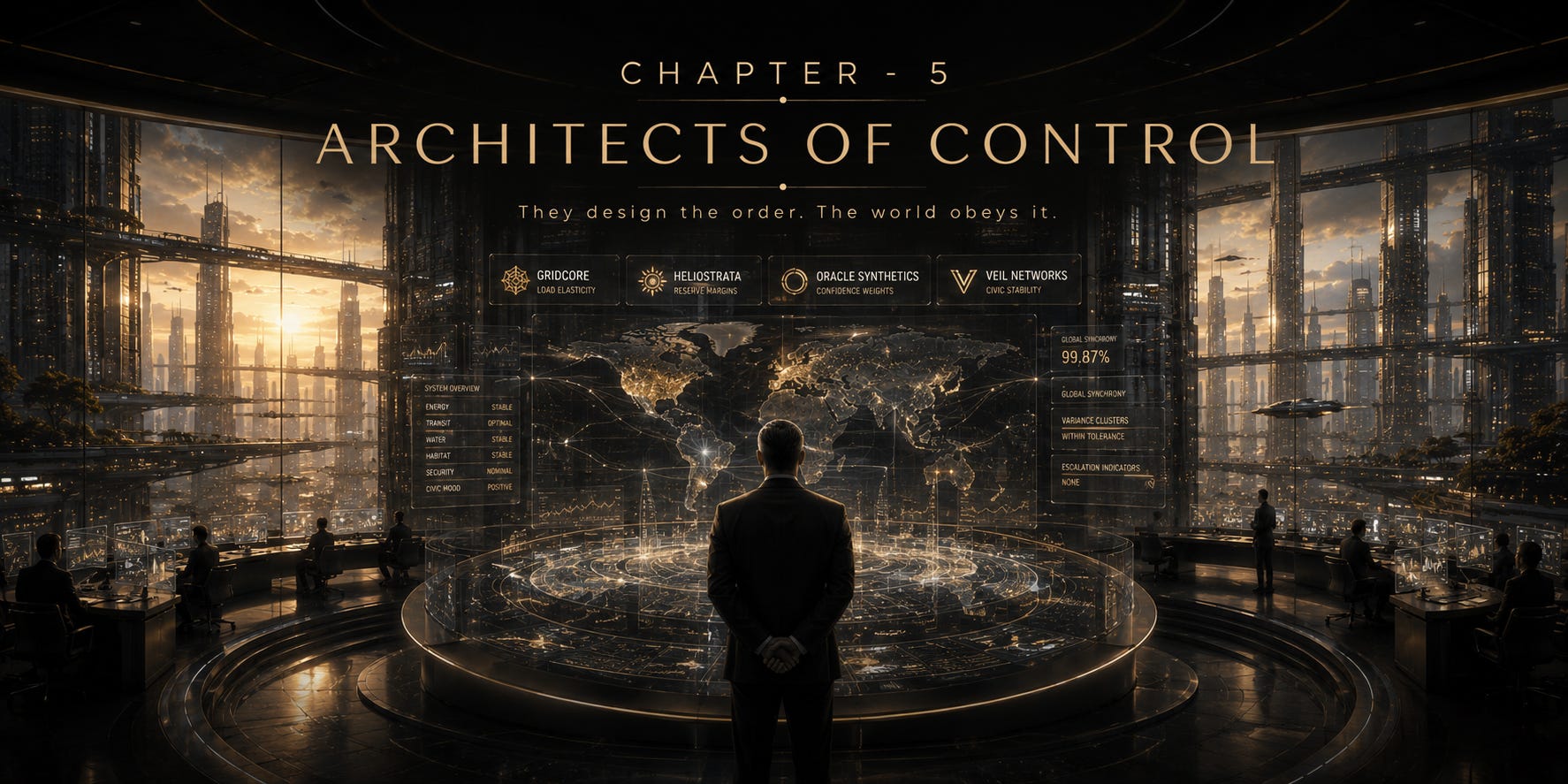
Chapter 5 – Architects of Control
Thursday, July 13th, 2045
Angelas Megacity
Angelas Federal Bloc
Victor did not hurry.
He moved at the pace the environment expected of him: neither hurried nor delayed. The upper tier had long since removed the need for urgency. Nothing here required reaction. It only required continuation.
The walkway curved ahead in a clean arc between towers that rose without visible interruption. Glass, pale composites, structural lines so precise they no longer read as structure. Every surface belonged. Nothing asked to be reconsidered.
Garden beds ran along the inner edge of the span, their root systems sealed beneath translucent composite and their leaves kept at a precise, ornamental wildness. Air posts stood between them at regular intervals, releasing faint threads of mineral sweetness into the morning. The scent was never strong enough to be noticed as scent. It simply made the air feel expensive.
Along the outer lane, private capsules detached from residential docks in timed intervals, carrying executives and senior administrators toward towers whose names rarely appeared on public maps. No vehicles idled. Nothing waited visibly. A capsule arrived only when its passenger had already become statistically ready to leave.
Nothing here asked him to negotiate with it.
Victor walked with his hands relaxed at his sides, his attention moving ahead of him rather than around him.
A school group crossed a lower-level walkway inside a transparent academy capsule, twelve children seated in two neat rows while an adult attendant stood near the door with nothing to correct. Their uniforms carried pale academy marks at the collar. Their attention was divided between the window and whatever lesson Veil had layered across the glass from inside. No clustering. No restlessness. No one pressing a palm against the surface to test the height.
He watched them for a moment longer than necessary. Indicator, not sentiment.
The absence of low-level vigilance. The quiet surrender of attention that used to live in the body. That was what stability looked like when it had matured: people stopped carrying it, and the system carried it for them. Victor let the academy capsule pass below and continued, the observation already filed as baseline.
The administrative arc opened before he reached it. Not enough to be called a threshold. Just a gradual easing of compression, the space adjusting so that by the time he stepped into it, it already felt different.
Victor moved through the space without slowing. The room did not require inspection. Inspection implied the possibility of deviation. Here, deviation was not a working assumption. Continuity was.
That expectation extended outward. Beyond the room. Beyond the tower. Across the entire upper tier. It did not need reinforcement. It had already been accepted.
The chamber accepted him without display. The floor recognized his step pattern and brightened the primary arc by a degree. Around the room, analysts occupied shallow stations set into the tiered floor. Each station was marked not by department name but by function: Load, Flow, Access, Sentiment, Continuity. The central field rested dark until Victor entered its radius. Then the composite unfolded upward, layer by layer, not projected from a single source but assembled from the room itself.
The command chamber was not designed to impress; it was designed to remove ambiguity.
Circular. Tiered. Every position placed in a precise relationship to the central field. No dominant chair, no theatrical focal point. Authority was not expressed through position here. It was expressed through clarity.
Victor stood within the primary arc as the composite resolved into full depth, assembling in the air around him and across the adjacent surfaces: regional and partner systems layered into managed synchrony.
GRIDCORE load elasticity sat at the base of the composite. HelioStrata reserve margins wrapped around it in a thin luminous band. Oracle Synthetics confidence weights moved through the upper layer, adjusting the brightness of each regional stream according to reliability. A Veil Networks civic-stability ribbon tracked sentiment drift below the infrastructure display, narrow and calm.
The structure gave the impression of separate systems choosing agreement. Victor knew better. Agreement had been engineered.
He felt the room settle around the images, not with tension, but with alignment. The kind of quiet that came when nothing needed to be negotiated.
He began without preamble.
“Current cycle holds across all primary layers. Minor variance clusters remain within tolerance. No escalation indicators.”
The statement required no invitation.
No one moved to interrupt. Not because of hierarchy, but because interruption required justification, and nothing in the statement created one.
Victor let the silence sit just long enough to confirm that.
Then: “A procedural note.”
The voice came from the secondary arc.
Victor already knew who it was.
Alina Sorel.
She did not speak often. When she did, it was because something had crossed from background noise into structured observation.
He shifted his gaze.
“Proceed.”
She didn’t step forward. Her data layer elevated instead, bringing a narrow slice of the composite into sharper resolution.
“The East Asia sovereign modeling partition remains non-propagating,” she said. “Metadata contraction persists across the Chinese stack, but no dependent systems have adjusted. No secondary variance clusters formed. Classification holds at partial-confidence context.”
Victor watched the layer not because he had missed it, but because Sorel had chosen to bring it forward. That mattered.
“It has persisted across two partner-system synchronization checks,” she continued, “without metadata expansion.”
Sorel’s layer divided again, narrowing to a secondary diagnostic band.
“Associated clinical compatibility noise has increased across lower-tier medical intake,” she said. “Device handshake irregularities. Unregistered architecture. Incomplete ledger authentication.”
Victor watched the band form, then compress itself almost immediately beneath the primary East Asia notation.
“Impact?”
“None at current scale,” Sorel said. “Patient outcomes remain within expected range. No mortality cluster. No service interruption. No propagation into licensed medical infrastructure.”
A smaller line surfaced beneath the clinical band:
UNLICENSED PERSONAL AUGMENTATION PATHWAYS
PROBABLE BLACK-ROUTE FIRMWARE PATCHING
CLINICAL RISK: LOW
The room did not react to it. It was the kind of line systems produced when uncertainty had been given a shelf to sit on.
Victor let it remain visible for a moment.
“Then it is not clinical strain,” he said.
“No,” Sorel replied.
“It is not infrastructure strain.”
“No.”
“And it is not behavioral spread.”
“Not presently.”
Victor looked back to the primary layer. East Asia. Partial confidence. Metadata contraction. No dependent adjustment.
“Then it remains context.”
Sorel held still for a fraction longer than the room required.
“Yes,” she said. “Context.”
The word settled cleanly. That was the purpose of classification: not to eliminate uncertainty, but to place it somewhere it could not interfere with action.
Limited review. Attention without concern. Ambiguity held in a container that looked procedural enough to avoid consequence.
“What outcome would review produce that classification has not?” he asked.
Sorel paused. Not hesitation. Filtration.
“Clarification,” she said after a moment.
Victor’s gaze flicked back to the data layer. Still contained. Still stable. Still irrelevant.
“Clarification for whom?”
She didn’t answer. She didn’t need to. Victor did it for her.
“For the observer,” he said. “Not for the system.”
“That is correct,” she replied.
The room recognized the boundary. Not agreement, exactly. Classification.
Victor stepped closer to the central field.
“The system does not require explanatory fullness to maintain coherence,” he said. “It requires outcome alignment.”
The composite continued its unchanged cycle in the space between statements.
“We have outcome alignment.”
No one moved.
“Classification exists to prevent informational noise from presenting as structural risk. Not every unresolved condition is a precursor state. Not every opacity event is instability.”
He watched attention move through the secondary arc and return to the composite.
“If the system does not propagate the condition, the condition does not rise.”
Silence followed for a beat.
“Review is appropriate when uncertainty threatens function,” he said. “This does not.”
Sorel inclined her head once. Not submission. Closure.
“Understood.”
Her layer receded and the space it occupied collapsed back into the composite, its weight gone the moment attention left it. Victor watched the system reassert its shape, unchanged, and that was the point.
Institutions did not fail because they encountered irregularities. They failed when they elevated them.
Noise was constant. Relevance was chosen.
“One further point, Director.”
Victor acknowledged without turning.
“If the condition persists across tomorrow’s cycle,” Sorel said, “should classification remain local, or transfer to continuity watch?”
“Local,” he said immediately.
“Even without metadata expansion?”
“Yes.”
She held the question a fraction longer. Victor turned to face her fully now.
Not for emphasis, for precision.
“Metadata is a narrative preference,” he said. “Continuity is a systems fact. We do not elevate facts because preferences remain unsatisfied.”
That settled it. Completely.
“Understood.”
Sorel’s gaze returned to the narrowed layer before she spoke again.
“There is slight divergence in cross-regional synchronization.”
Victor waited.
“…still within tolerance.”
He nodded once.
“Then there is no divergence.”
“Understood, Director.”
The exchange ended there. Not by authority. By definition.
The composite display settled back into alignment. Each layer smoothing until nothing asked to be isolated. Victor remained still, watching the system hold its shape.
He didn’t measure time; time was incidental. What mattered was persistence, whether anything drifted, whether anything failed to return. Nothing did. A tertiary layer surfaced briefly, a minor compression across long-range logistics. It resolved before it could propagate, absorbed cleanly into the wider structure.
Victor registered the outcome, not the adjustment that produced it. Correction had completed before consequence formed. That was sufficient.
“Predictive alignment maintained.”
The statement passed through the chamber without resistance. No objections followed. There was no reason for them. The cycle closed quietly, without emphasis. Continuation was strongest when no one needed to name it.
Victor remained in the chamber after the others had begun to disperse. Not out of obligation. There was no need to linger. Nothing required follow-up. No unresolved threads sat waiting for attention. The system had already absorbed them.
Still, he stayed.
The composite held steady in front of him, its layers settling into quiet equilibrium. Movement continued, but it no longer registered as change. Only as continuity.
This was the point most people misunderstood: stability was not stillness. It was motion without consequence.
He let his gaze move across the upper bands. Infrastructure. Governance. Flow. Each layer feeding the next, each dependency resolved before it could express itself as strain. Years ago, this would have required active oversight. Teams. Escalation chains. Redundancies stacked on top of one another, each compensating for the failure of something else.
Now though, the system compensated for itself. Not reactively, structurally.
He shifted his focus downward. To the lower tiers.
Higher variability and more noise. Human density still expressed as unpredictability in real time and in the data, though both had narrowed. The edges were cleaner now. Fewer anomalies reached the surface, and fewer interruptions required intervention.
Not because people had changed, but because the environment no longer allowed deviation to accumulate. It was handled before it became visible. That was the real achievement. Not control: preclusion.
A small cluster formed along a transport spine in the southern corridor. Density rising just enough to register. A delay, if left alone, might have compounded. It didn’t. Routing adjusted and flow redistributed. The cluster dissolved into the wider pattern without leaving a trace.
Victor watched it happen, then let it go. It had not lasted long enough to become instruction.
He moved from the primary arc station, descending one level without looking back. The chamber recalibrated around his absence, roles shifting, responsibilities redistributing without instruction. No one needed to be told what to do next. They already knew.
More precisely, the system already knew, and they operated within it.
That distinction had taken years to stabilize. Early implementations had failed at the local layer. Operators optimized for the problem in front of them. District managers protected visible performance. Human supervisors widened margins when they felt pressure and narrowed them when praise depended on efficiency. They introduced sympathy, caution, ambition, and fatigue. Variables, all of them.
The later architecture had not removed human judgment completely. That would have been impossible. Instead, it had placed judgment inside channels narrow enough that it could no longer disturb the whole.
He stepped into a transitional corridor. The lighting adjusted subtly, narrowing just enough to guide movement without signaling it, and the surfaces shifted from open composite to a tighter, more structured material language: function leading form, as it should.
Victor felt the change, not as a sensation, but as an alignment. The environment reducing unnecessary variables as he moved deeper into the operational complex.
Execution, not presentation, was where the system expressed itself most clearly.
A secondary operations hub opened ahead. This was not a presentation chamber. It was where presentation was made possible.
The space was smaller than the main room and less ceremonial, with lower ceilings, tighter station arcs, and data layers kept closer to the body. Here, raw alerts arrived before language softened them. Operators did not brief one another unless a condition survived refinement. Most did not. A red tick entered the room as a problem and left it as a routing note, a latency adjustment, a classification downgrade.
By the time information reached Victor’s level, it had already learned how to behave.
Victor paused at the threshold. Not to announce himself. To observe. This was the control room, and he was the architect of what would be allowed to become visible.
A deviation alert surfaced briefly in one sector. Not large enough to escalate. Not small enough to ignore. One of the analysts shifted focus, isolating the layer, and a second joined without prompting. Data was refined. Parameters adjusted. The alert collapsed. In under three seconds, emergence had become resolution without escalation and without noise.
Victor stepped inside. No one turned. They had registered him already, and here acknowledgment was unnecessary.
He moved between stations, his attention passing over their work without interrupting it. Each layer he glanced at told the same story.
Compression handled, variance contained, outcomes aligned.
He stopped behind one station; it was displaying a logistics band, mid-range distribution.
“Status,” he said.
The analyst didn’t turn.
“Within tolerance,” she replied. “Minor routing adjustments. No propagation.”
Victor watched the layer for a moment. She was right. Of course she was.
“Continue.”
Victor let the station fall behind him.
At the far end of the room, a wall display carried a simplified abstraction of the wider partner network. It existed for orientation, not analysis.
As he approached, most of the details stripped away. What remained was pattern, and the pattern held. There was no fragmentation, no clustering beyond expected ranges. No regions trending toward instability.
Standing before it, Victor knew what mattered: not the individual events, not the localized adjustments, but whether the pattern held. He felt it then, as confirmation settling into place.
The system worked in practice, at scale, across complexity that would have been unmanageable even a decade earlier. He remembered the early objections: too many dependencies, too much opacity, too much risk in allowing systems to self-regulate.
They had misunderstood the achievement. Control had not been lost. It had been relocated into the structure.
He exited the operations level, and the environment opened again, returning him to the broader spatial language of the upper tier. The light expanded and the surfaces softened. The density of information reduced to near-zero by design; mature systems did not ask to be watched every second.
A structure this stable did not require constant engagement. It required trust. The final barrier had not been technical. It had been human: the inability to release control once it had been achieved. Victor had never struggled with that; he knew control was not something you held. It was something you built into the structure of a thing so completely that it no longer required you.
He stepped onto another elevated walkway and the city stretched out beneath him, vast and ordered, every layer feeding the next in quiet coordination. From here, nothing looked strained and nothing looked uncertain.
And more importantly – nothing felt like it could become either of those things.
Victor watched it for a moment, then continued along the path. He had almost cleared the span when the layer surfaced. Not in front of him. Not in the chamber. In his peripheral. A quiet pull at the edge of attention, the kind that normally resolved before it could fully form.
He didn’t stop walking. The system didn’t require him to. The layer clarified on its own, sliding into visibility without requesting focus. A narrow band within the wider composite, isolated but not flagged. East Asia again. The same narrow condition, still held at the edge of the composite like a file left open after review.
Victor let the layer complete its cycle. Metadata remained contracted. Confidence remained partial. Dependency mapping showed no spread into trade, energy, migration, or defense layers. The condition had shape, but no consequence.
Consequence was the threshold, and the condition had not crossed it.
A transport vector shifted below him, rerouting through a secondary channel. The visible flow obeyed immediately. The confidence layer took longer, a fractional delay between movement and confirmation.
It would not survive audit as an event. It barely survived attention as one.
Victor did not stop or turn back.
The layer did not return, and that was what mattered. If it had persisted, expanded, or begun to express itself across dependent systems, then attention would have been justified. It did none of those things. It remained local, then disappeared.
Confirmation settled into place, not as relief, but as alignment reasserting itself. The system had encountered a condition, evaluated it, contained it, and resolved it without requiring escalation. Doctrine had become procedure.
He reached the end of the span and walked into the next structure without breaking stride. Behind him, the city continued its motion, each layer feeding the next in seamless coordination. No noise reached him, and Victor did not look back. No condition remained visible enough to justify attention.
And yet, for a moment, brief enough that it never fully surfaced, he considered the difference between resolution and persistence.
Not as a question but as a classification. Then he let it go; there was no need to hold it because the system had already answered.
Somewhere below the visible layer, a clinical compatibility band refreshed and remained where it had been placed. Context. Low risk. No propagation.
Victor continued forward, the environment unfolding ahead of him in controlled sequence, the system carrying itself without further claim on him.
The walkway carried him out beyond the immediate cluster of towers, the spacing widening just enough that the verticality began to reveal itself again, not as a feature, but as a condition you could forget if you stayed inside it too long.
From here, the city did not feel tall, it felt layered. Depth expressed downward in bands that softened as they descended, light diffusing through suspended infrastructure, transit lines threading between structural ribs, entire districts stacked in clean, deliberate strata. Movement existed at every level, but none of it collided. Each layer knew where it belonged.
That was the difference, not height, but agreement.
A vertical transit column opened to his right, its interior visible through a transparent sheath that ran the full height of the structure. Capsules moved within it in silent succession, rising and descending in precise intervals, each one arriving exactly where it needed to be without pause. He turned away before the capsule reached the uppermost band.
A terrace extended along the outer edge of the structure, not for congregation, but for continuity. A place where the interior and exterior blurred without forcing interaction.
Victor stepped onto the terrace without breaking stride.
The air was different here. Not fresher. Just less processed. A subtle variance, intentional. Enough to remind the body that it still existed, without introducing unpredictability.
He moved along the edge, the city opening out beside him.
There had been a time when this view would have carried weight, when height meant risk, exposure, a calculation between fascination and fear. That response was gone now, not suppressed, but replaced. Height had become infrastructure, something to be used rather than reacted to.
A maintenance unit moved along the outer skin of the tower below, its motion precise, almost delicate as it adjusted a surface panel by a fraction that would never be noticed from inside. Victor watched it for a moment, not the unit itself, the absence of interruption.
There was no pause in the systems it touched and no visible seam where correction occurred. The structure did not acknowledge maintenance.
It incorporated correction. That was the final step: not eliminating failure, but eliminating the visibility of it.
A child’s voice carried briefly from somewhere behind him, small enough that it didn’t disrupt the space, just enough to register as something unscripted. Victor did not turn. The sound faded almost immediately, absorbed into the wider quiet. For a moment, the absence it left behind was more noticeable than the sound itself. Then that, too, resolved.
He moved deeper into the structure, the environment closing gently around him, restoring the baseline conditions of the upper tier. External variance and environmental noise fell away; continuity returned without announcement.
His path curved again, guiding him back toward his residential band without requiring a decision. The system did not direct him, it anticipated him. That had been the argument, early on; whether anticipation would ever feel like constraint. It had not, because it was usually correct, and usually had become enough.
Victor stepped through the final transition point and into the private arc. The space adjusted instantly. The light softened. The sound dampened further. The last traces of shared environment fell away.
The room contained almost nothing that was not responsive. A table surfaced only when required. The wall cleared itself when his attention moved toward it. Seating adjusted by posture prediction rather than command. There were no photographs, no fixed artwork, no objects placed simply because they had once mattered. Permanent things introduced unnecessary claims on attention.
A decompression protocol offered itself in the lower edge of his vision: reduced luminance, respiratory pacing, HDC executive recovery sequence. Victor dismissed it without irritation. Recovery implied depletion. He preferred transition.
He stopped this time, not to observe. To exist within it.
The room held steady around him, every element placed exactly where it needed to be, nothing asking for adjustment, nothing requiring attention.
This was what they had built: not merely a system that worked, but one that no longer needed to prove itself.
Victor stood there for a moment longer, his attention settling into the quiet completeness of it. Then, without hesitation and without second thought, he allowed the next sequence to begin.