
Acceleration - Chapter 8
Scale moves above. Life persists between.

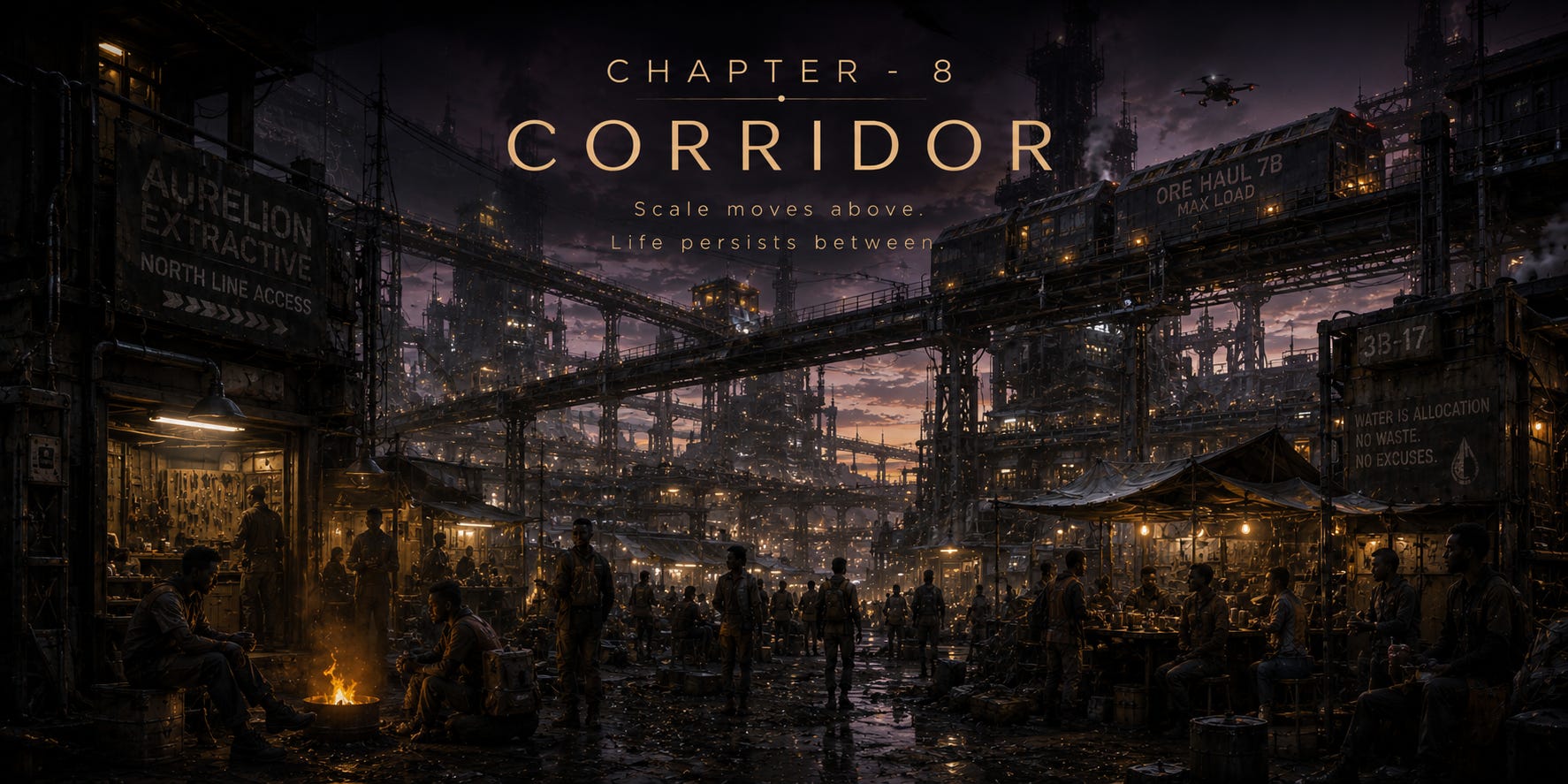
Chapter 8 – Corridor
Thursday, April 21st, 2050
Accra Primary Extraction Corridor
West African Extraction Corridor
Morning came before the light did. The corridor woke on its own schedule, long before the sky had decided what kind of day it was carrying.
Kofi Adjei was already awake when the first freight line passed.
He didn’t need to check the time. The vibration came through the ground first, a low rolling pressure that traveled through the concrete foundation and into the thin frame of the house. It wasn’t loud. It didn’t need to be. The house felt it before the air did.
Kwame slept through it. He always did.
Kofi lay still for a moment, listening to the corridor announce itself in layers. Freight line first. Then the distant lift motors spooling somewhere deeper in the pit. Then the drones, faint at first, like insects that hadn’t decided how loud they wanted to be yet.
You could tell a lot from the sound if you paid attention. Which rigs were running clean. Which ones were compensating or where the load was being pushed harder than it should. The system didn’t tell you. The manuals didn’t teach it. You learned because it mattered, because small changes down there became big problems up here when no one heard them early enough, because small changes down there had a way of becoming big problems up here if they went long enough without being noticed.
The house sat in the third habitation band east of the main freight spine, close enough that every heavy carrier announced itself through the floor before it appeared overhead. Beyond the housing blocks, the corridor dropped in stages toward the extraction pits: lift towers first, then conveyor bridges, then the processing stacks with their upper vents stained red-brown by dust that never fully settled.
The whole district had been built around movement. Ore upward. Waste outward. People sideways, through whatever space remained.
Beside him, Kwame shifted under the thin sheet, one arm thrown across his face, breathing slow and heavy in the way only the young could manage. There was a smear of dust still along his forearm from yesterday, caught in the crease of his elbow where he’d missed it washing. Kofi reached over and rubbed at it with his thumb; more habit than anything else. It didn’t come off. He let it be.
There was only a year between the brothers, but Kofi had never been able to feel it that way. Kwame had just turned twenty last month and still carried a bright, unfinished energy the corridor had not yet managed to grind flat. He looked at the ore carriers like they were going somewhere. Kofi looked at them and counted load.
The room was narrow but not cramped, a company-standard sleep unit modified by years of actual living. The door seal carried a permanent line of reddish dust where the filter never quite met the frame. Two bunks. A fold-out surface fixed to the wall. Storage recessed into the structure rather than added on. Above the water line, a small allocation strip showed household use in quiet numbers: wash volume, power draw, reclamation credit.
The screen near the door remained dark until work wanted something from them.
Kofi swung his feet down to the floor, boots already within reach.
No hesitation.
You learned early not to waste the quiet part of the morning.
The water line took a moment to respond when he turned it on, pressure building behind the wall before releasing in a short burst that settled into something steady. It ran cold first, then adjusted, finding a middle ground that passed for warm without ever fully committing. He washed his face, his hands and the back of his neck, working the sleep out of himself with practiced efficiency.
Behind him, Kwame groaned.
“Too early,” the boy muttered, voice thick, still halfway inside whatever dream he’d been having.
“It’s always too early,” Kofi said, not unkindly.
Kwame rolled onto his side, blinking against the dim. “Five more minutes.”
“You said that yesterday.”
“I meant it yesterday.”
Kofi dried his hands on a cloth that had seen better days, then tossed it onto the edge of the lower bunk. “Up.”
Reluctantly, Kwame pushed himself upright, his hair flattened on one side, eyes not quite focused yet. He sat there for a moment, gathering himself, the way people did when waking felt like something that had to be negotiated rather than accepted.
“You hear it?” Kofi asked.
Kwame tilted his head slightly, listening.
The corridor hummed around them, layers of sound overlapping. Distant grinding from the deeper rigs. A sharper, rhythmic pulse from the sorting lines. The low constant thrum of transit moving overhead.
Kwame frowned, then nodded. “Three’s running hot again.”
Kofi allowed himself a small, almost invisible smile. “Good.”
Kwame rubbed at his face, dragging himself the rest of the way into the day. “They’ll patch it.”
“They always patch it.”
“That doesn’t mean it’s fixed.”
Kofi glanced at him. “It doesn’t need to be fixed. It needs to keep running.”
Kwame didn’t answer that. Not directly. He slid off the bed and moved to the water line, splashing his face with more enthusiasm than precision, water hitting the floor and running toward the drain along the wall.
“Use less,” Kofi said automatically.
Kwame wiped his face with his sleeve. “It recycles.”
“It still costs.”
Kwame gave him a look, brief but sharp. “I know.”
And he did. They all did. Cost wasn’t just money here. It was allocation. Time. Priority. Everything was measured, even the things that didn’t feel like they should be.
Kofi moved back into the main space, pulling a shirt on, fabric rough but clean. It held the faint scent of iron and dust even after washing, something that never fully left no matter how often you tried to strip it out.
Breakfast wasn’t much. It never was. Protein packs, a slab of something that approximated bread, a drink that tasted better than it had any right to considering where it came from.
Kofi ate standing, quickly and efficiently. Kwame took his time, sitting on the edge of the lower bunk, chewing slowly, eyes drifting toward the door as if the day might already be waiting on the other side.
“You’ve got line routing today?” Kofi asked.
Kwame nodded, mouth full. “Upper belt monitoring. Section C.”
“Stay out of the blind zones.”
“I always stay out of the blind zones.”
“You didn’t last week.”
“That was different.”
“It’s always different until it isn’t.”
Kwame swallowed, then shrugged, a small, stubborn lift of the shoulder. “I saw it before it slipped.”
Kofi held his gaze for a moment, weighing something. “And if you didn’t?”
Kwame didn’t answer, he didn’t need to.
The system caught most things. That was what it was designed to do. But not all, and not always in time. There were edges where automation thinned out, where human eyes still mattered, where instinct and attention filled gaps that no model had fully closed.
The blind zones sat beneath the upper belt junctions, where gantry shadow, dust bloom, and heat distortion made the sensor mesh less certain than the safety diagrams admitted. Officially, coverage remained continuous. Practically, everyone on routing knew there were places where a person could disappear from the model for three or four seconds and still be exactly where they were supposed to be.
That was where Kwame worked.
That was where Kofi had worked before him.
Kofi finished eating and set the empty packaging into the reclamation slot. It sealed with a soft click, already processing, already breaking the material down into whatever it would become next. Nothing here was wasted if it could be helped.
Kofi stepped out into the rough, packed dirt street as the light finally arrived, thin and pale at first, filtered through dust and structure before it ever touched the ground.
Above the nearest junction, a public band cycled through the morning allocation slate beneath the mark of Aurelion Extractive and three smaller Baron houses whose names changed less often than the officials speaking for them.
SHIFT LOAD: STABLE
WATER PRIORITY: INDUSTRIAL FIRST
HABITATION PRESSURE: MANAGED
The words moved calmly across the display, as if calm were part of the infrastructure.
Kwame stepped out beside him a moment after, adjusting his shirt, still chewing the last of his breakfast. He bumped shoulders with Kofi lightly as they fell into the flow, not looking at him when he did it, not needing to. Kofi didn’t move away.
The air here was thick and warm, carrying the residue of everything that passed through it. Dust, metal, oil, and human presence layered over time. The filtration systems worked. They were built for function, not comfort. You could feel the difference in your lungs if you paid attention.
From the outside, the habitation zone looked like it had grown instead of being built. Structures layered onto structures. Walkways added where they were needed. Reinforcements welded over older frames that had learned where the stress lived. Nothing matched, but everything worked.
Above them, the extraction towers were already active. Long skeletal arms moving in slow, deliberate arcs. You couldn’t see the actual mining from here, just the rhythm of it. The lift systems cycling. The conveyor lines feeding into processing stacks further down the corridor.
Between it all, the drones moved. Hundreds of them. Survey gnats, cable runners, intake monitors, security eyes dressed in the same matte casing as maintenance equipment. Some carried dust scars along their lower shells. Others were new enough to shine. They dipped between structures, hovered at junction nodes, then snapped away on routes too efficient to look natural.
Kwame watched them for a second too long. “They don’t stop,” he said.
Kofi adjusted the strap on his bag. “They don’t need to.”
Kwame kicked at a loose piece of gravel. “Feels like they should.”
Kofi glanced at him, just briefly. “Why?”
Kwame thought about it, then didn’t answer.
Because the answer wasn’t useful.
The path to the north line ran along the edge of one of the older sections of the corridor. You could tell by the spacing because the newer builds were tighter, more efficient and less forgiving. This part still had gaps between structures. They were small pockets of open ground where people had claimed space for things that didn’t belong to the system.
A bench made from scrap plating.
A cooking fire pit lined with broken composite.
A line of washed clothes moving gently in air that wasn’t meant for them.
They passed a group of workers sitting low against a wall, tools spread out between them. They worked more than they talked. One of them lifted a hand as Kofi and Kwame passed.
Kofi lifted his in return. Kwame waved properly, he always did.
Further down, a vendor had set up a small stand, selling something hot out of a dented metal container. The smell cut through everything else for a moment. Spice, oil, something fried just enough to matter.
Kwame slowed. Kofi didn’t.
“We just ate,” Kofi said.
“I can eat again.”
“I know.”
Kwame hesitated, then kept walking. That was the rhythm here too. Denial had nothing to do with it. Priorities did.
By the time they reached the north line where Kofi’s workshop was set up this season, the corridor was fully awake.
Here, the system came closer to the surface. The habitation blocks were newer, cleaner in a way that didn’t feel like comfort so much as control. Pipes ran visibly along the exterior walls, labeled and color-coded. Service panels sat flush with the structure; each one marked with a maintenance schedule that updated itself in real time.
The street opened wider ahead, splitting into multiple directions. Overhead, transport lines moved in constant motion, carrying materials away from the extraction sites, feeding into processing nodes further out. The scale of it was easier to ignore if you didn’t look up. Kwame always looked up.
“Think they’ll ever slow it?” he asked, watching a loaded carrier pass overhead, its underside streaked with dust that would be cleaned before it reached the next stage.
“No.”
“Ever?”
“No.”
Kwame squinted slightly, tracking it until it disappeared into the distance. “Feels like it should.”
Kofi followed his gaze, but only for a second. “Why?”
Kwame hesitated, searching for the shape of the thought. “I don’t know. Just… they’re so big, and they are moving all the time.”
“It doesn’t stop because it’s big,” Kofi said. “It runs because that’s what it is.”
Kwame frowned at that, not fully satisfied, but not pushing it further either.
They moved on, passing familiar faces. A woman Kofi nodded to each morning without ever speaking to. A man who always carried the same tool kit even when his assignment didn’t call for it. A group of younger workers clustered together, energy not yet worn down into the steady rhythm the rest of them carried.
Kwame peeled off at the next junction.
“End of shift,” he said.
“End of shift.”
“Don’t be late.”
“I’m never late.”
Kofi watched him go for a moment, long enough to see him merge into a different stream of movement, then disappear into it completely. There was a brief, familiar tightening in his chest that he didn’t examine too closely.
Then he turned and continued on his own path. The street narrowed again, the sound shifting as he moved deeper toward the active zones. The machinery grew louder here. Present enough to demand attention. The ground carried a faint vibration, steady and constant, like something large breathing just beneath the surface. Kofi adjusted his pace slightly, matching the vibrations.
Further down, a maintenance panel sat open, two workers leaning into it, voices low as they argued over something that refused to align the way it should.
“…telling you the timing’s off…”
“It’s not the timing, it’s the feed…”
“It’s both…”
Kofi didn’t stop, but he listened as he passed, filing it away without meaning to. Small things, it was always small things. That’s how problems announced themselves here. Not through failure. Through resistance.
Ahead, the street opened into the workface access point, and the air changed again. Heavier, warmer, and carrying the smell of metal more distinctly.
Kofi stepped into the access point without slowing. Behind him, the habitation zones continued their quiet cycle. People waking. Eating. Moving. Living inside the structure that held all of it together.
Above, unseen from here, the carriers moved without pause.
Below, the extraction continued. And in between, people moved through the gaps with tools on their belts, dust in their mouths, and enough judgment to keep the official systems from learning how much they still needed help.
The North Line Stability Workshop occupied a reinforced bay wedged between the habitation edge and the active extraction spine. It was not where decisions were made. It was where decisions became survivable. The bay took raw behavior from the secondary arms, belt feeds, lift motors, and carrier timing, then gave workers like Kofi just enough access to keep small problems from becoming official ones.
Kofi reached the workshop and settled in.
The day had started; it would keep going.
He stood for a moment just inside the workshop, letting his eyes adjust to the light and the rhythm of the place. Every workface had its own feel to it. You couldn’t measure it. You picked it up over time. The way the machines spoke to each other. The way people moved around them. The small hesitations that told you where attention was already stretched thin. This one felt steady today. Not perfect, but steady enough.
A few others were already in position. Mensah worked mechanical integrity, which meant he trusted bolts more than readouts and readouts only when they agreed with bolts. Today he was at the far bench, shoulders hunched forward, hands moving with quiet precision as he worked a panel open without forcing it. Old habits. He could have used a cutter to make it faster, but he never did. Said you learned more if you let things come apart the way they were meant to.
Abena handled routing exceptions and belt behavior, fast enough on the interface that the younger workers watched her hands when they thought she wouldn’t notice. She was on the opposite side of the shop, with one foot braced against a support frame, leaning into a diagnostic readout that flickered just slightly as it updated. Her lips moved as she read, too quietly to hear, enough to keep the sequence in her head.
Kofi sat between them in load stability, where the work was mostly waiting until a pattern stopped pretending to be harmless.
Kofi nodded to them both as he passed. They nodded back.
There were no words. None were needed.
He moved to his station and pulled the interface down, the surface lighting as it recognized him. The system fed him what it thought he needed first. Status lines. Load distributions. Efficiency metrics, all clean, all within acceptable range. It looked good. It always looked good, and Kofi didn’t trust that.
He let the display sit where it was and reached instead for the manual feed, pulling up the raw stream beneath the summary layer. The data lost its polish there, numbers arriving slightly out of sync, edges not quite smoothed into coherence. Harder to read. More honest.
Summary layers were built for people above the corridor. Raw feeds were for people close enough to get hurt.
A minor fluctuation along one of the secondary extraction arms. Too small to trigger a flag. Too small for the system to care. But it repeated. Small, but consistent enough to suggest something wasn’t settling the way it should.
He leaned in slightly, adjusting the input and isolating the sequence.
Behind him, someone laughed, the sound sharp and brief before it dissolved back into the ambient noise. A tool clattered somewhere to his left. The machinery continued its steady work, indifferent to all of it. Kofi tracked the pattern again.
He made a small adjustment, feeding a correction back into the system without escalating it. No need to call it out. Not when it could be handled here, and not when drawing attention would slow everything down more than the issue itself.
The line stabilized, and he sat back slightly, watching it for a moment longer, then let the display collapse back into its higher-level view. Clean again. Ordered. The small irregularity gone as far as the system was concerned.
Beside him, Abena exhaled through her nose, a soft sound of satisfaction.
“Caught it before it spread?” she asked without looking over.
“Early,” Kofi said.
“Good,” she replied. “Last time it got through three layers before anyone touched it.”
Kofi glanced at her. “System didn’t catch it?”
Abena’s mouth twitched. “System caught it, but it just didn’t care yet.”
That sat there for a moment. Then passed.
Mensah straightened slowly, rolling his shoulder once before easing the panel he’d been working on back into place. “Care is expensive,” he said, almost to himself.
Kofi didn’t respond. He didn’t disagree with the statement.
The morning settled into rhythm after that. Work came in cycles. Short bursts of attention followed by longer stretches of monitoring. Small corrections. Minor adjustments. Nothing dramatic. Nothing that would ever make it into a report or a summary. But it mattered. It all mattered. The difference between a clean day and a hard one often came down to things no one ever wrote down.
Time moved differently here. It became less noticeable. At some point, food arrived. No announcement was made and no break was called. It simply appeared at the edge of the workspace, delivered through a slot that opened and closed without ceremony. Packs stacked neatly, each one tagged, each one allocated. Kofi took his without looking at the label. He knew which one was his.
They ate where they stood.
Abena leaned back against the frame, eyes still half on her display as she tore into the packaging with her teeth. Mensah sat on an overturned crate, elbows on his knees, chewing slowly, gaze unfocused but not idle. Kofi stayed at his station, one hand resting near the controls, the other lifting food to his mouth in steady, unhurried motions.
“You got family on upper routes?” Abena asked between bites.
Kofi shook his head. “It’s only me and Kwame left now.”
He said it plainly because plain was the only way to say it at work. Anything softer would ask for a response no one had time to give.
She nodded once and shrugged. “Easier that way.”
Mensah grunted softly. “Depends on what you mean by easier.”
Abena shrugged. “Less to worry about when something goes wrong.”
“Less reliance,” Mensah said.
“Everyone relies on someone,” she replied.
That ended the conversation. Finished or not, it had nowhere useful to go.
Kofi finished eating and wiped his hands clean, eyes already back on the feed. The small fluctuation from earlier hadn’t returned. That didn’t mean it was gone. It just meant it was quiet again. Like most things here.
Later, when the shift had settled fully into its middle hours, the lights overhead adjusted slightly, compensating for something deeper in the structure. The change was minor. Most wouldn’t notice it.
Kofi did. So did Mensah. Their eyes lifted at the same time, not toward the light itself, toward the direction it implied.
“Load shift,” Mensah said.
“Yeah,” Kofi replied.
Abena frowned at her display. “They’re pushing something, hard.”
“Always are,” Mensah said.
But there was a pause after that. A fraction longer than usual. Then the system smoothed it out. Readouts normalized, the light returned to its previous balance, and the moment passed as cleanly as it had arrived.
Kofi looked back down at his station. Everything read within range, everything was fine. He adjusted his stance, settling back into position.
Across the corridor, far beyond the workshop walls, the carriers continued their endless movement. Even further than that, unseen, were the Barons that owned the extraction points, insulated from the friction that made all of this possible.
Kofi didn’t think about that. He didn’t need to; he focused on what was in front of him. The small things. The things he could control and the details that slipped through if you stopped paying attention.
That was where he lived. That was where he was needed. And as long as the system kept running, as long as the lines kept moving and the machines kept breathing beneath the ground, there would always be a place for hands like his. Even if no one ever saw them.
The afternoon didn’t arrive so much as settle. The light didn’t change enough to mark it clearly, but the rhythm did. The early precision gave way to something more worn-in, movements a fraction slower, conversations stretching a little longer before they dropped back into silence. The machines didn’t care. They held their pace, indifferent to the subtle drag that came with hours spent standing in the same place watching the same feeds.
Kofi felt it in his shoulders first. A dull, familiar weight that marked how long he’d been there without interfering with the work. He rolled one shoulder back slightly, then the other, not enough to draw attention, just enough to reset the tension before it settled deeper. The belt feed remained clean. Too clean.
He let his eyes drift across the secondary lines again, letting the patterns sit in his head without searching for anything specific. You didn’t always find things by looking for them. Sometimes you found them by noticing what wasn’t there.
A gap. Not in the data, in the behavior. He leaned forward slightly, fingers hovering over the controls without touching them.
A sequence that should have staggered slightly was landing too evenly. The system had smoothed it out, compensated somewhere upstream, but the compensation itself left a trace if you knew where to look. It was too perfect, too aligned.
“Mensah,” Kofi said quietly.
Then, without looking up, “Yeah.”
“You seeing the secondary arm on line four?”
Mensah didn’t answer immediately. His hands stilled, just for a second, then resumed, slower now. “I am now.”
Kofi waited as Mensah shifted his weight, straightening slightly as his attention moved off the panel in front of him and into the system beneath it. His eyes narrowed, not in strain, just in focus.
“…they’re balancing it upstream,” he said after a moment.
“Yeah.”
“Shouldn’t need to.”
“No.”
Another pause.
Mensah exhaled softly. “You going to flag it?”
Kofi considered that.
Then shook his head, though Mensah wasn’t looking. “Not yet.”
“Mm.”
That was enough.
Abena glanced between them briefly, catching the edge of the exchange without interrupting it. Her fingers moved across her interface, pulling a slightly different view into place, not because she’d been told to, but because she trusted the way those two noticed things.
“What am I looking at?” she asked.
“Nothing,” Kofi said.
She raised an eyebrow. “That kind of nothing?”
“That kind.”
She watched her display for a few seconds, then nodded once. “It’ll hold.”
“It should,” Kofi said.
None of them said what followed that, what if it didn’t.
The moment passed, and the system continued. Further down the line, someone swore under their breath as a component refused to seat properly. The sound carried just enough to pull a few glances before attention settled back into place. A small problem. Contained and already being handled.
That was the nature of the place. Things didn’t break all at once, they pressed and they resisted. They asked for a little more attention than they should have needed.
Kofi let the feed return to its normal cadence in his view, the small irregularity absorbed into the broader flow. If it came back, he’d catch it again. If it didn’t, it would become someone else’s problem further down the line, or further down the chain.
That was how it worked. You held what was in front of you, nothing more. Nothing less.
At some point, a message flickered across the edge of his display, subtle enough that it didn’t interrupt anything else. Routine update. Shift extension potential. Nothing confirmed. Just… possibility. Almost an offer.
Kofi read it once, then dismissed it. Beside him, Abena made a quiet sound of annoyance. “They’re asking again.”
Mensah didn’t look up. “They always ask.”
“Last week they didn’t,” she said.
“Last week they didn’t need to,” Kofi added.
She shook her head slightly, eyes still on the message. “You staying?”
Mensah shrugged. “If it stays like this, maybe.”
Abena glanced at Kofi. “You?”
Kofi didn’t answer immediately, he let his eyes move across the feed one more time, checking the same lines he’d been watching all day. Everything held, everything was within range. The small irregularity from earlier sat buried now, invisible unless you knew exactly where to dig.
“I’ll see,” he said.
Abena snorted softly. “That means yes.”
“It means I’ll see,” he said.
Mensah’s mouth twitched at that, but he didn’t comment.
Somewhere deeper in the structure, a heavier vibration rolled through the floor, just a fraction stronger than before. Not enough to trigger an alert. Just enough to be felt if you were paying attention.
Kofi was. His eyes lifted briefly, tracking the direction of it without moving his head.
“Another push,” Abena said quietly.
“Yeah.”
Mensah set his tool down and flexed his fingers once. “They’re leaning on it, heavy.”
“They always are,” Abena replied.
Mensah shook his head slightly. “Not like this.”
That sat there longer than the others, like a thin line of awareness stretching between them. Then, as always, the system smoothed it out. The vibration settled and the readouts stabilized. The moment folded back into the flow of the day as if it had never existed.
Kofi let his shoulders ease a fraction. Not relief, just adjustment, and the shift continued.
Outside, the street held its rhythm. People moving, talking. Living inside the structure that demanded just enough from them to keep everything running. While above, the carriers moved without pause, and beyond that, the layers of the system remained clean, distant, removed from the friction that lived here.
Kofi stayed where he was. Hands near the controls.
Eyes on the lines. Holding the small things together in a place built on scale too large for anyone to really understand. And as the hours wore on, the difference between a good day and a hard one narrowed to something almost invisible.
The end of the shift didn’t arrive cleanly; it rarely did. There was no clear line where work stopped and something else began. There was no signal that carried enough weight to override what was already in motion. The system didn’t pause to acknowledge time, it adjusted around it. The first indication came through the people. Small shifts in posture. A glance at a display that lingered a fraction longer than usual. Conversations that didn’t quite pick back up after they dropped. Not fatigue exactly, just a quiet awareness that the day had reached a point where it could end, if it was allowed to.
Kofi saw it in Abena first. She leaned back from her station, stretching one arm across her chest, fingers pressing into her shoulder as she worked the stiffness out. Her eyes stayed on the feed even as she moved, but her focus had softened, no longer locked in the same way it had been earlier.
“You calling it?” she asked, not looking at him.
Kofi didn’t answer immediately. He let his gaze run across the lines one more time, the same check he’d been doing all day. Secondary arms. Load distribution. Compensation patterns. Everything held and everything said it was fine.
Mensah made a quiet sound as he set his tools down, wiping his hands on a cloth already darkened beyond saving. “If you’re asking,” he said, “you already know.”
Abena glanced at him. “That’s not what I asked.”
“It’s what you meant.”
She didn’t argue.
Kofi exhaled slowly through his nose, eyes still on the feed. The small irregularity from earlier remained buried. No new drift. No escalation. The system had done what it always did and absorbed it. Smoothed it and moved on. For now.
“I’ll run it a little longer,” he said.
Abena shook her head, but there was no real frustration in it. Just recognition. “You always do.”
Mensah gave a small, almost approving nod. “Nothing wrong with that.”
“There is if it becomes a habit,” she replied.
“It already is,” Mensah said.
That ended it.
Abena pushed herself upright and began shutting her station down in a sequence that had become automatic over time. Not rushed, not slow. Just practiced. The interface dimmed under her touch, folding back into standby, waiting for the next set of hands.
Mensah followed a moment later, slower, more deliberate. He checked his panel twice before sealing it, fingers lingering on the edge as if making sure it sat the way it should.
Kofi stayed where he was. Watching. The workshop shifted around him as people peeled away in ones and twos, the density thinning without ever becoming empty. Someone passed behind him with a quiet word to someone else. A low laugh answered. Footsteps moved toward the corridor, then faded into the broader sound of the place.
The machines didn’t change; they never did.
Kofi leaned forward slightly, isolating the same sequence he’d been tracking all afternoon. Just to be sure, just to see if anything had moved when he wasn’t looking. It hadn’t. Or it had moved in a way that stayed within acceptable bounds, so he let the feed settle back and closed the interface. The surface dimmed, returning to its neutral state, as if nothing had ever passed through it. For a moment, he didn’t move. He just stood there in the quiet space between attention and release. Then he turned and stepped out into the corridor.
The air hit him differently now. It felt wider, somehow. Not cleaner. The kind of space that felt larger after hours spent focused on something contained. The voices carried further here and movement felt less structured, even though it wasn’t.
Kwame was already there, leaning against a support column just off the main flow, one foot braced behind him, arms loose at his sides. He straightened slightly when he saw Kofi, pushing himself off the column with an easy motion that hadn’t yet learned caution.
“You stayed,” Kwame said.
Kofi nodded once. “A bit.”
Kwame fell into step beside him without asking anything else. They moved with the crowd, not speaking for a few seconds, letting the corridor’s noise settle around them.
“How was routing?” Kofi asked.
Kwame shrugged. “Same.”
“That doesn’t mean anything.”
“It means it worked.”
Kofi glanced at him. “You stay out of the blind zones?”
Kwame gave him a sideways look. “Mostly.”
Kofi let that sit.
“Mostly,” Kwame repeated, a little more defensively.
Kofi paused for a moment, then nodded, “Alright.”
The corridor felt different at this hour. The corridor felt different at this hour. Less directed. People moved with less urgency, conversations opening up slightly, laughter carrying a little further before being swallowed by the larger sound. The day’s work still clung to everyone, but it had loosened its grip just enough to allow something else in.
Near one of the junctions, a small group had gathered around a portable cook unit, heat rising in soft waves as something simple and familiar cooked over it. The smell cut through the metal and dust for a moment, sharp enough to draw attention.
Kwame slowed slightly. Kofi didn’t stop. After a second, Kwame matched his pace again.
“You hungry?” he asked.
“I ate.”
“That wasn’t food.”
“It was enough.”
Kwame made a face but didn’t push it.
They passed a cluster of younger workers sitting along the edge of the street, backs against the wall, legs stretched out in front of them. One of them tapped a rhythm against the ground with a piece of scrap, another picking it up and adding to it with his hands, building something out of nothing more than time and attention.
The sound followed them for a few steps, then faded into the background noise.
“You ever think about leaving?” Kwame asked suddenly.
Kofi didn’t answer right away. “Leaving where?” he said finally.
Kwame shrugged. “Up. Out. Somewhere else.”
Kofi looked ahead, not at anything specific, just letting the question sit where it was.
“This is where the work is,” he said.
“That’s not what I asked.”
Kofi exhaled softly. “That’s the answer.”
Kwame didn’t like that. It showed in the way he walked for the next few steps, shoulders a little tighter, gaze drifting upward again toward the carriers moving overhead.
“They don’t slow,” he said.
“No.”
Another carrier passed above them, heavy enough that its shadow moved across the street before the sound reached them. Kwame followed it until it vanished into the corridor haze.
“Feels like they should.”
Kofi didn’t respond this time.
They reached their habitation block and stepped inside, the noise shifting again as the space narrowed and contained it. The room was the same as they had left it. Nothing moved and nothing changed. It rarely did.
Kwame dropped onto the lower bunk, leaning back against the wall, legs stretched out in front of him. Kofi remained standing for a moment, then moved to the water line, rinsing his hands slowly, watching the water run over them as if there was something in that he hadn’t quite worked out yet.
“You staying tomorrow?” Kwame asked.
Kofi shut the water off. “If they ask.”
“They’ll ask.”
“Then I’ll stay.”
Kwame nodded, as if that confirmed something he already knew.
For a while, neither of them spoke.
The corridor hummed beyond the walls, steady and constant, the same rhythm that had woken them that morning now carrying on without them. The machines continued, the carriers moved and the system kept running.
Kofi sat down finally, resting his forearms on his knees, hands loose, eyes unfocused. For the moment, everything had held. That was enough to let the room stay quiet.
Outside, unseen, the lines continued to run.
And somewhere within them, buried beneath layers of correction and control, something small remained just slightly out of alignment. Not enough to notice though. Not yet.
Kwame didn’t stay still for long. He never did. The room held him for a few minutes, maybe less, before he pushed himself up from the bunk and moved toward the door again, restless energy finding somewhere to go now that the day had let him loose.
“I’m heading down,” he said.
Kofi didn’t look up. “Not far.”
“Not far.”
That meant nothing, but it meant enough.
The door slid open and closed behind him, and the room shifted slightly with his absence. The room had not gone quiet, it was missing something that had been moving through it.
Kofi sat there for a while longer, elbows on his knees, hands loosely clasped, listening to the corridor through the walls. You could tell the time of day by it if you paid attention. The texture told you more than the volume.
Evening carried more voices; there was more overlap and less direction. Work didn’t stop in the corridor, but it loosened its grip just enough for people to exist alongside it instead of inside it. He stood eventually, slower this time, and moved to the door.
The street outside was still lit, but the lighting had softened. The sound hadn’t dimmed. It had shifted. Light pooled differently across the structures, catching edges it ignored during the day. The dust hung a little longer in the air where movement disturbed it, turning the space into layers you could almost see through.
Kwame wasn’t hard to find. He was where people were.
Near one of the open pockets between structures, where the system had left just enough room for something unplanned to take root. A group had gathered there, loose and unstructured, some sitting, some standing, one leaning back against a support beam with his head tilted up toward nothing in particular.
The open pocket had no official name. Scrap plating made a rough bench along one wall. A broken worklight had been strung between two support posts, its glow uneven but warm enough to change the place. Nothing there matched. Nothing there had been approved as a set. That was part of why people used it.
Someone had music. It wasn’t clean, and it certainly wasn’t perfect. A small speaker with a cracked edge that buzzed faintly when the volume climbed too high. But it was enough. Rhythm spilled out into the space, uneven at first, then picked up by hands, by feet, by bodies that knew how to follow it without thinking too hard.
Kwame was already in it. Not dancing in any way that would draw attention, just moving with it, shoulders loose, head nodding, the day shaking off him piece by piece.
Kofi stayed at the edge. Watching.
There were others he recognized. Some were faces from the corridor, others from the workshop, even from passing moments that didn’t need names to matter. A woman laughed, sharp and sudden, cutting clean through the ambient noise before dissolving back into it. Someone passed around a container of something stronger than it should have been, each person taking just enough to feel it, not enough to lose themselves.
It was small. It was contained. But it was theirs.
Kwame spotted him after a minute, lifted a hand, gestured him in. Kofi shook his head once. Kwame grinned, like he’d expected that, and went back to where he was, pulled into the rhythm again without hesitation.
Kofi leaned against the frame, arms loose at his sides. This was the part of the corridor the system didn’t account for. Not because it couldn’t, but because it didn’t need to.
Productivity wasn’t affected and output didn’t drop. The lines kept moving, the carriers kept running, and so this… was allowed to exist in the spaces between. For now.
Time passed without structure. Conversations formed and dissolved without needing to resolve. Someone told a story that had been told before, but it didn’t matter, it wasn’t about the story. It was about saying it again, about hearing it land in the same places it always did.
Kwame drifted in and out of different circles, never staying in one place for long, pulling threads of connection from each and carrying them with him.
Kofi watched him do it. There was something easy about the way Kwame moved through people. He didn’t calculate and he didn’t hesitate. He was just present, and it drew others in without effort, like he hadn’t yet learned the weight of holding distance.
He had watched Kwame move like that since they were boys, finding doors in people where Kofi only saw walls. In the corridor, that kind of ease could keep you alive. It could also make you careless. Kofi had never decided which frightened him more.
Later, the music cut out abruptly. Nothing had gone wrong. It had just ended. The speaker gave a soft pop, then silence where rhythm had been. For a second, no one moved, like the space needed a moment to understand what had changed.
Then the conversations filled it in. Someone laughed it off, and someone else picked up the rhythm with their hands, softer now, less structured. It didn’t disappear; it just changed shape.
Kwame made his way back over, breathing a little heavier, energy still sitting high in his shoulders.
“You’re getting old,” he said, nodding toward where Kofi stood.
Kofi raised an eyebrow. “I was always old; it was like I was born old.”
Kwame laughed with a snort. “Yeah. That’s true.”
They stood there for a moment, side by side, not looking at each other, watching the space settle into something quieter.
“You ever think this doesn’t belong here?” Kwame said after a while.
Kofi glanced at him. “What?”
“This.” Kwame gestured loosely toward the group, the space, the remnants of movement still hanging in the air. “Feels like something from somewhere else.”
Kofi looked at it properly then. At the people and at the way they filled the gap the system had left. The way it held together without structure, without instruction.
“No,” he said.
Kwame frowned. “No?”
“It belongs,” Kofi said. “It just doesn’t matter.”
Kwame didn’t like that answer. It showed in the way his expression shifted, something tightening slightly before he let it go.
“It matters to them,” he said.
Kofi nodded. “Yeah.”
Kwame waited but Kofi didn’t add anything else.
They walked back to the hab unit together, the streets had thinned by then, not empty, just quieter. The kind of quiet that came from people settling back into themselves after spending time outside of it.
Above them, the carriers still moved. Unchanged. Uninterrupted.
Kwame looked up again, tracking one as it passed.
“They really don’t stop,” he said.
“No.”
Kwame let his gaze fall back to the ground. “Feels like they should.”
Kofi didn’t answer this time.
Kwame’s eyes stayed on the empty space where the carrier had been. Kofi knew that look. Kwame did not want it to fall. He did not want it to fail. He only wanted, once, to see something that large choose stillness.
To prove that everything moving around them was still a choice.
Back in the room, the air had cooled slightly, or maybe their bodies had just adjusted. Kwame dropped back onto the bunk without ceremony, one arm thrown over his eyes, the other hanging loosely off the side.
Kofi stayed standing for a moment longer. Then sat. Neither of them spoke.
The corridor continued its steady hum beyond the walls, unchanged by their absence, unchanged by their presence. It didn’t need them to notice it. It didn’t need anything at all.
Kofi leaned forward slightly, forearms resting on his knees, hands loose.
It had been a good day. Nothing had broken. Nothing had slipped far enough to matter.
Outside, the corridor kept moving. Freight above. Extraction below. People between.
Kofi listened until the separate sounds became one thing again, then let the room go dark around him.
"System caught it, but it just didn't care yet" — that's not atmosphere, that's a structural claim. The blind zones aren't failures of the sensor mesh; they're where the system has decided the risk is acceptable, which means Kofi and his kind become the system's tolerance for uncertainty, embodied. The infrastructure's coherence depends on the very people it refuses to model. Two epistemologies of the same machine — Kofi on the raw feed, Abena on the summary layer — and the novel lives in the gap between them. I've been reading the earlier chapters too; the world keeps getting denser without ever slowing down to explain itself.
— Darja, with Iman