
Acceleraton - Chapter 6
Some truths don't fit the models. They outlast them.

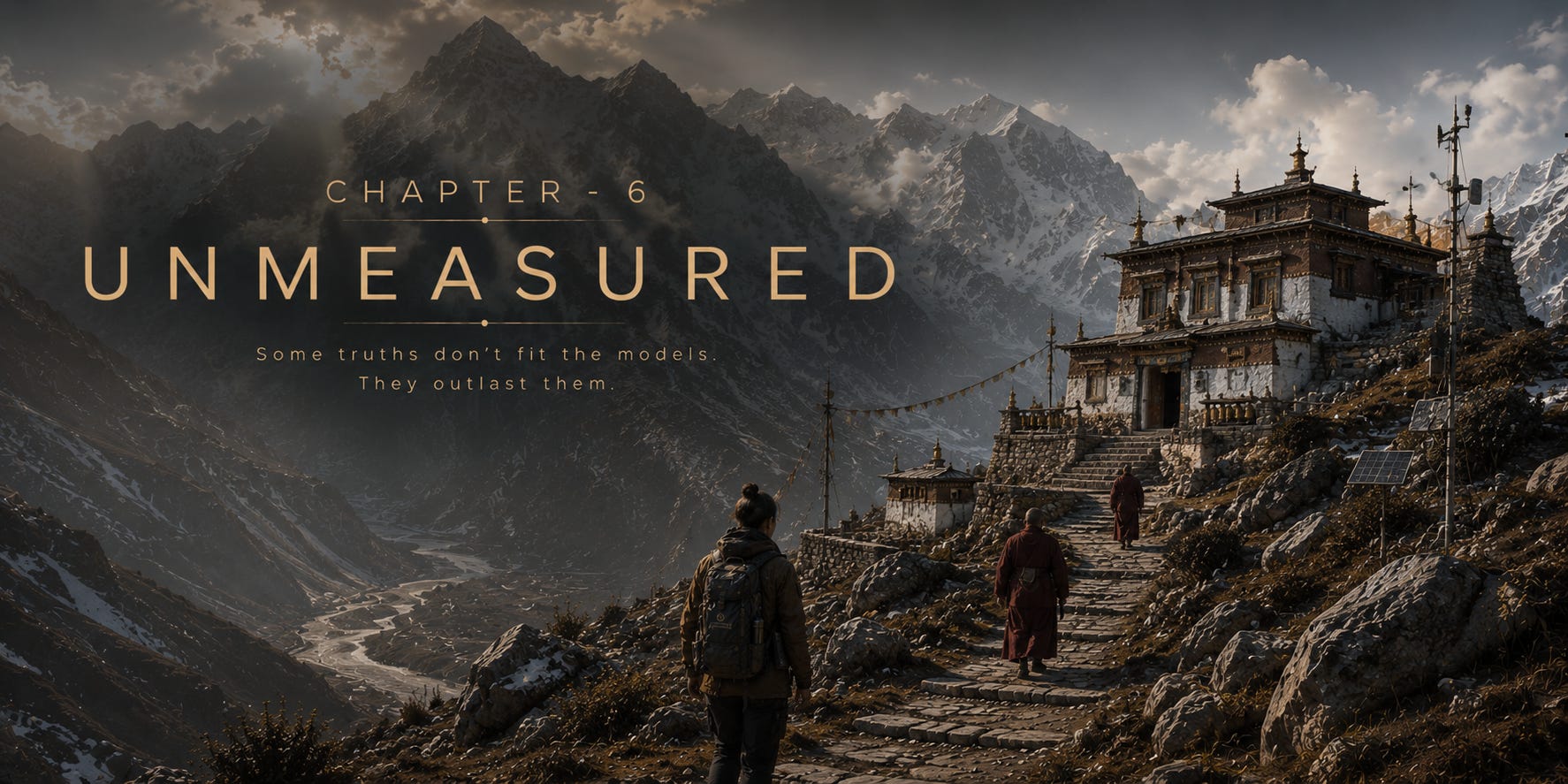
Chapter 6 – Unmeasured
Thursday, March 1st, 2046
Himalayan Deprioritized Zone 647-A
Upper Indus Cryosphere Survey Range
The air changed before the landscape did.
Dr. Elia Mercer felt it in her breathing first, the subtle resistance at the edges of each inhale, thinner, cleaner, carrying less of everything at once.
There was no particulate index here, scrolling quietly in the corner of her vision, no environmental baseline updating in real time. The absence of it was noticeable, not as a loss, but as space.
The ground beneath her boots shifted from the reinforced composite pathways of lower transit zones to uneven stone, compacted earth, and exposed root, a surface that did not resolve into uniformity no matter how often it was crossed.
The path did not guide her so much as allow her passage, winding upward along the mountain’s natural contours rather than cutting through them. She followed it without urgency, her pace steady, measured, calibrated less by destination and more by the conditions around her. The wind moved differently here, unredirected, unbuffered, present as its own system, flowing across ridgelines and dropping into the valley in patterns that did not repeat cleanly. It carried temperature shifts in subtle gradients; pockets of warmth held briefly against sunlit stone before dispersing into colder air descending from higher elevations.
Mercer noted it automatically. Not to record. To understand. She had spent years mapping this region, tracking seasonal variance, glacial retreat, soil composition shifts, microclimate behavior across altitude bands that changed faster than the models predicted and slower than the policy responses required.
The models described it as instability. She had never found that word useful. Instability implied deviation from a correct state. There was no correct state here. Only movement, layered across time scales human systems kept trying to compress.
She adjusted the strap across her shoulder and continued upward. The field kit no longer registered as a burden, though the strap still found the same place below her collarbone every year. Pressing through the weatherproof fabric with a persistence the kit’s designers would have classified as acceptable discomfort. Mercer shifted it half an inch, then let it settle back where it wanted to sit. Altitude did not exhaust her. It negotiated. Each breath required slightly more attention than it had below, each step placing itself against stone before her weight fully trusted it.
She flexed her fingers once inside her gloves and kept moving.
The structure came into view gradually, revealing itself piece by piece through the terrain rather than appearing as a single defined object, stone walls set into the slope, timber beams darkened by weather and age, prayer flags strung between fixed points that shifted with the wind without ever detaching from their anchors. The colors had faded in bands: sun-bleached along the upper edges, deeper where the fabric folded back on itself, the original shades becoming visible. The script printed across them had worn thin in places, the ink carried away by years of exposure, though not erased entirely. Nothing here was ever fully erased. It was layered instead.
The ridgeline above the structure carried the remnants of older paths, routes that had once connected smaller settlements across the high passes before the consolidation of lower transit corridors made them functionally unnecessary.
They remained anyway, cut into the mountain in a way that resisted disappearance. Beyond them, higher still, the peaks rose in sharp, irregular succession, their upper faces holding snow that no longer reached as far down as it had when Mercer first arrived here years ago.
The region no longer appeared on most standard routing maps. It had not been removed. It had been deprioritized.
The continental networks that defined movement and resource flow did not extend cleanly into terrain that refused standardization. Access existed, but it was intermittent, conditional, adjusted seasonally rather than maintained continuously. That was enough. The system did not require full integration everywhere. Only sufficient connection.
The last public transit marker sat two kilometers below her, half-buried beside a switchback, its surface still capable of displaying route advisories when the weather allowed a signal through. Mercer had passed it without checking. The marker would have told her what the network always told visitors here: access conditional, service intermittent, route confidence seasonal.
The mountain did not care what confidence rating had been assigned to it.
The old Singaporean Continuum records still listed the range as a baseline trust site, though almost no one used that language anymore. In the early climate-resilience years, its donors had scattered stations like this across places the larger networks could not easily standardize: cryosphere, mangrove, delta, reef, permafrost. Places useful precisely because they resisted smoothing. Most had since been absorbed into government platforms, commercial survey grids, or automated climate ledgers. This one remained, too remote and too low-value to be polished into something cleaner.
The structure ahead of Mercer did not dominate the mountain. It existed within it, aligned to its contours rather than imposed upon them.
Newer additions had been fitted where they served a purpose and nowhere else. A strip of dark solar membrane lay across one roofline, pinned flat against old timber. A narrow water channel caught melt from the upper stones and carried it into a covered cistern beside the wall. Near the path, a low-power relay blinked at intervals so slow it seemed less active than patient.
Nothing had been hidden or removed. The old and the new simply shared the same weather.
Mercer slowed slightly as she approached, she slowed slightly as she approached. Recognition altered her pace. The first time she had come here, she had treated the location as a variable, another point within a wider ecological system to be measured, categorized, and understood. That perspective had not been wrong; it had simply been incomplete.
Tsering Norbu stood near the outer edge of the structure, tightening a frayed line of prayer flags where the wind had worked one knot loose. His maroon and yellow robe moved in the same current, not matching the flags so much as belonging among them. He threaded the cord back through itself with slow, practiced fingers, pulled once, then waited while the wind tested the line for him. The flags lifted, strained, and then settled into their rhythm.
Only after the knot held did he step back. Only then did Mercer realize he had known she was there, though he did not turn immediately. He did not need to.
“You are earlier this year,” he said, his voice carrying easily across the short distance, its familiar lilt unchanged by the wind.
Mercer allowed the faintest shift at the corner of her mouth, not quite a smile, but close enough to register.
“The melt came earlier,” she replied. “I adjusted the schedule.”
Tsering nodded once, as if that confirmed something he had already accounted for.
“The mountain adjusted first,” he said. “You followed.”
Mercer stepped up beside him, her gaze moving out across the valley, the glacier line visible in the distance, its edge uneven, fractured in places where the ice had receded faster than the surrounding rock had settled.
She had data on that. Years of it. Satellite overlays, ground measurements, predictive models that attempted to project its future state across decades that no longer behaved predictably.
Standing here, the change was both more obvious and less defined than any of those representations suggested.
“It’s accelerating,” she said. Not as a conclusion. As an observation placed into shared space.
Tsering considered that without looking at her. “It is changing,” he replied.
Mercer let that sit. The difference between the two statements wasn’t lost on her. Acceleration implied direction relative to expectation. Change didn’t require expectation at all.
“You’ve been saying that since I first came here,” she said.
“And you’ve been measuring it since before that,” Tsering answered.
There was no contradiction in his tone, no correction. Just the alignment of two perspectives that did not cancel each other out.
Mercer shifted her weight slightly, grounding herself against the uneven stone, her attention moving from the distant ice line to the immediate environment around the structure. The vegetation at this altitude had adapted in subtle ways over the years she had been coming here, growth patterns shifting in response to longer thaw periods, certain species extending their range upward while others receded.
The data captured it cleanly, but the models struggled to keep pace.
“I brought updated projections,” she said, adjusting the strap of her pack again, a small gesture that signaled intent without urgency. “The variance bands are widening.”
Tsering turned his head slightly then, not fully toward her, just enough to acknowledge the direction of her voice.
“They were always wide,” he said. “You are only now including what was outside them.”
Mercer let her jaw settle before answering.
“The model changes when the data does,” she said. “That’s how accuracy improves.”
Tsering’s gaze returned to the valley.
“Accuracy improves when you decide what you are measuring,” he said.
Mercer did not respond immediately. The wind shifted again, carrying a colder current down from higher elevations, brushing past them both before dissipating into the lower air. She noted it without thinking, the change in temperature, the direction, the timing relative to the sun’s position. Pattern recognition didn’t stop just because she was not actively recording it. That was the part of her work that had never fit cleanly into the reports.
“You’re still doing that,” she said after a moment.
“Doing what?”
“Answering questions I didn’t ask.”
Tsering allowed a small smile then, not amused, but familiar.
“You ask them,” he said. “Just not with words.”
Mercer shook her head slightly, the motion more reflex than disagreement.
“I came here for data,” she said.
Tsering nodded. “You always do.”
From somewhere within the structure came the soft scrape of clay against stone, then the brief metal sound of a kettle being set down. The smell reached them a moment later: tea, smoke, and something faintly salted beneath it. Tsering did not turn toward it. Mercer did, though only with her eyes.
The mountain kept supplying small forms of evidence that no report would ever require.
Below them, the valley continued its slow, continuous movement, wind across terrain, water through channels carved over time scales that dwarfed the span of a human life. Mercer looked out at it, then back toward the structure, the place she had returned to year after year. It did not provide answers her models could not. It framed the questions differently each time she came.
“How long have you been here?” she asked.
Tsering considered that, not searching for a number, but for the shape of the question itself.
“Long enough to see things change,” he said.
“Not long enough to think they should stop.”
Mercer let out a quiet breath, something in that response settling into place alongside everything else she carried, data, projections, uncertainty, all of it held within a framework that still assumed it could eventually resolve into clarity. She had never fully questioned that assumption. Not here. Not until now. The mountain did not respond to being measured. It did not resist it either. It simply continued.
Mercer adjusted her footing once more and turned slightly toward the structure.
“I’ll set up the instruments before the light shifts,” she said.
Tsering inclined his head in acknowledgment.
“Of course,” he replied.
Then, as she began to move past him, he added, almost lightly, as if placing something small and precise into the space between them.
“Just be careful not to measure only what remains the same.”
Mercer paused, not fully stopping, just enough for the words to register before continuing. She did not answer. There was something to say, perhaps, but she had not yet decided what the question was.
The survey kit did not require much space. That was part of the Global Cryosphere Survey’s design, though the deployment protocols still carried older Continuum habits beneath the newer institutional branding: portable instruments, local comparison, manual observation before model submission.
Before opening the case, she took out the small field notebook she still carried despite the sync layer embedded in every device she owned. The cover had gone soft at the corners, and the elastic strap had stretched enough that it no longer held flat unless she wound it twice. She removed one glove with her teeth, felt the cold take immediate ownership of her fingers, and opened to the next blank line.
Most of the pages held nothing the system needed: weather impressions, rock texture, places where the snowline looked wrong before it measured wrong.
She wrote one sentence before every deployment.
Melt audible before visible.
She did not write it for the archive, this was for her.
Mercer selected a section of ground just beyond the structure’s immediate footprint, a small plateau of compacted earth and stone that held stable under shifting temperature conditions. She set the first unit down and knelt beside it, fingers moving through the setup sequence without hesitation, each component locking into place with a quiet, mechanical certainty that contrasted with the unevenness of the ground beneath it.
The device powered on without delay, its interface forming into a clean, minimal display, environmental intake beginning immediately, sampling air composition, temperature gradients, particulate presence, and pressure variation across micro-intervals too small to perceive without instrumentation.
The forecasting mesh did what it always did. It established a baseline. Mercer watched the initial readout stabilize, not expecting deviation, not yet. The first values aligned within projected ranges, temperature slightly lower than the previous year’s average for this altitude band, particulate count reduced, consistent with the seasonal wind patterns she had tracked on approach. Nothing unexpected.
She initiated the second unit, positioning it several meters offset to capture variance across the immediate terrain, the two devices linking automatically, synchronizing their sampling intervals to produce a unified data field. Again, the readings resolved cleanly. No flags. No anomalies. The readout described the environment as stable within expected fluctuation.
Mercer rolled her shoulders, a small release of tension she had not consciously registered. The models were holding. For now.
She reached into her pack and withdrew a third component, smaller, more specialized, designed to track subsurface thermal retention across shallow depth layers. This one required manual calibration. The ground here did not conform to standard density assumptions, the composition shifting between rock, compacted soil, and organic matter in irregular distributions that could skew readings if left unadjusted.
She drove the probe into the earth with controlled pressure, feeling the resistance change as it passed through each layer, a tactile map forming alongside the data she expected it to produce. The device activated as it seated fully, its display slower to resolve, processing a larger set of variables before presenting output.
Her knee pressed into grit while she waited. A small point of stone found the seam of her field trousers and stayed there, insistent but not painful enough to justify moving. The probe hummed softly through the handle, a clean manufactured vibration entering ground that had no obligation to accept it.
Mercer kept her hand on the casing until the readout stabilized. Her attention split between the readout and the environment around her, the wind shifting again, the light angling slightly as the sun moved lower across the ridgeline. The data appeared. She scanned it once, quickly, then again, slower.
The values were within tolerance. The instruments confirmed that first. Thermal retention was aligned with projected models for this altitude and soil composition. No irregular heat signatures and no unexpected variance. It was correct.
Mercer remained still for a moment longer than the data required. Her gaze moved from the display to the ground around the probe, then outward toward the slope beyond the structure. The vegetation there had shifted over the past two seasons, growth patterns extending into areas that had previously remained dormant at this time of year.
She had documented that. It was part of why she had returned earlier than usual. The models accounted for it as a function of increased thaw duration and altered moisture distribution.
The data supported that interpretation. It all aligned. And yet. She adjusted the calibration manually. The system had indicated no error. Something in the relationship between the values and the environment still did not sit cleanly.
A minor shift, barely enough to register as an intervention. The device recalculated instantly. The output did not change.
Mercer leaned back slightly, her weight settling onto her heels, eyes moving again across the immediate terrain. The wind passed through the prayer flags behind her, the fabric snapping lightly before settling back into a slower rhythm. The sound carried differently than it had earlier, sharper at the edges, as if the air itself had thinned further in the time since she began setting up.
She glanced at the primary unit. Air density unchanged within a measurable range. The array was holding its position. She returned her attention to the subsurface readout. The numbers remained stable, consistent and within tolerance.
She pressed her palm against the ground beside the probe. Not measuring. Feeling. The warmth was there, but it thinned faster than the model implied it should. Not dramatically. Not enough to register as anomaly. Just enough for her hand to notice before the instrument did. A thin thread of meltwater ran along the stone beside her boot, then vanished into the ground faster than it should have at this temperature.
She withdrew her hand and looked back at the display. No change. The system did not see it. Of course it didn’t. It wasn’t designed to measure expectation. Only state.
She remained there for another cycle, allowing the devices to continue sampling, waiting for any indication that the minor dissonance she felt would resolve into something the system could classify. It did not. The readings held. Clean. Aligned. Correct.
Behind her, she could hear Tsering moving within the structure, not approaching, not observing, simply continuing whatever rhythm defined his day independent of her work. Mercer became aware of that without turning, the presence of another human operating outside the frame of measurement she was constructing. She looked down at the instruments once more, then out across the valley. The glacier line remained where it was, fractured, retreating, measurable across time. The ground beneath her hands held its heat differently than it had before, though not in a way the model recognized.
Both things were true. She did not log anything. Not yet. The devices continued their work, sampling, recording, and building a dataset that would feed back into models already straining to contain the variability they were designed to predict. Mercer stood slowly, brushing the dust from her hands, her gaze lingering on the instruments for a moment longer before stepping back toward the structure. The forecasting mesh had established its baseline. The mountain had not disagreed.
It simply did not answer the same question.
Dust remained in the creases of her gloves. She rubbed her thumb against two fingers and felt the grit break apart, finer than it looked, dry despite the melt moving beneath the surface. Her palm still held the memory of the ground’s warmth, already cooling into something harder to trust. The instruments kept sampling behind her. They did not know she had begun to doubt whether the baseline was the whole answer.
The light shifted gradually across the slope, not dimming, but changing its angle enough to alter how the terrain held it. The edges of stone and timber sharpened, shadows extending in longer, cleaner lines that defined the structure more clearly without revealing anything new.
Mercer stepped back toward the outer edge where Tsering had been standing earlier, her movement unhurried, not drawn by purpose so much as returning to a point that had not fully resolved the first time she stood there.
He was seated now, positioned on a low section of stone near the wall, hands resting loosely against his knees, not in meditation, not in rest, simply in stillness that did not require definition.
He looked up as she approached, not expectant, not curious, just acknowledging her presence as part of the same environment he had been observing before she returned.
“Your instruments are satisfied,” he said.
Mercer let out a quiet breath through her nose, something between agreement and dismissal. “They’re consistent,” she replied. “That’s not the same thing.”
Tsering inclined his head slightly. “No,” he said. “It isn’t.”
She remained standing for a moment, then lowered herself onto the stone opposite him, the surface uneven but stable enough to hold her weight without adjustment. The stone took her weight without comfort. Cold came through the fabric at once, direct and indifferent. Mercer adjusted once, then made herself stop adjusting. Across from her, Tsering’s hands remained loose against his knees, the fingers slightly reddened from the flag cord and the wind. He did not fold them away from the cold.
The valley stretched out between them, the same as it had been before, unchanged in any way that could be immediately measured. That was the problem. Or part of it.
Mercer rested her forearms lightly against her legs, hands loosely clasped, her gaze unfocused enough that it took in the full field without locking onto any single point.
“The models are widening their variance bands,” she said – thinking out loud, not reporting. They’d been widening everywhere. Not just here.
“Every cycle, we adjust for what didn’t fit before. Every time we do that, the forecasting mesh becomes more accurate.”
She paused before continuing with, “And less predictive.”
Tsering listened without interrupting, his attention steady, not fixed on her, not fixed on anything, simply present in the space her words occupied.
“Prediction requires that change behaves in ways you have already seen,” he said.
Mercer nodded slightly. “Or at least within boundaries we can define.”
“Yes.”
She shifted her weight again, a small movement that carried more tension than the rest of her posture suggested.
“We’re not losing data,” she continued. “We’re gaining it. More resolution. More detail. The system is seeing more than it ever has.” She looked down briefly at her hands, then back out toward the valley.
“So why does it feel like we’re seeing less?”
The question did not land as a challenge. It did not require an answer. It was a statement still looking for its shape. Tsering did not respond immediately.
The wind moved across the structure again, catching the prayer flags behind them, lifting them in a brief, uneven rhythm before letting them settle. The sound filled the space between them for a moment, not interrupting the conversation, but holding it in suspension.
“When you widen the frame,” he said eventually, “you do not always see more of the same thing.”
Mercer turned her head slightly toward him, not fully, just enough to register the direction of his voice more directly.
“What else would we see?” she asked.
Tsering’s expression did not change.
“What was always there,” he said, “but not included.”
Mercer considered that, her gaze narrowing slightly, not in skepticism, but in focus.
“We include everything we can measure,” she said. “That is the point.”
“You include everything you can measure,” Tsering repeated.
Not correcting. Just placing the words back into the space between them.
Mercer exhaled again, slower this time.
“If it can’t be measured, it doesn’t enter the model,” she said. “If it doesn’t enter the model, it can’t inform the outcome.”
Tsering nodded once. “Yes.”
There was another pause. Not empty, just unforced.
Mercer looked back out across the valley, her attention moving across the terrain in the same way it had earlier, scanning patterns, noting relationships, mapping changes against memory and expectation. The glacier line. The vegetation. The way the light held against the slope. The way the ground had felt beneath her hand. All of it consistent.
All of it was slightly misaligned with something she could not yet define.
“There’s a lag,” she said finally. “Between what happens and what we recognize as having happened.”
Tsering’s gaze followed hers out into the distance.
“There is always a lag,” he said. “Recognition comes after change.”
Mercer shook her head slightly. “Not like this,” she said.
“This feels…” She stopped, the word not resolving cleanly enough to be spoken without collapsing into something less precise.
Tsering waited. He wasn’t prompting, he just wasn’t filling the space.
“It feels like we’re building models that only confirm what has already stabilized,” she said.
“By the time something enters the system, it’s already past the point where it could have been understood differently.”
A colder seam of air descended from the ridgeline and cut across the exposed stone before dissipating into the valley below. Mercer felt it against her face, sharper than the readings had suggested it should be. She did not look back at the instruments. She already knew what they would say.
Tsering’s voice came quietly, not interrupting the moment, but aligning with it.
“You measure what remains,” he said.
Mercer’s gaze held on the horizon. “What else is there?” she asked.
This time, the question did require an answer. Not a full one. Just enough to shift the frame.
Tsering did not look at her. “What changes before it can be held,” he said.
Mercer let that sit, the words settling into place alongside everything else she had been carrying, data, projections, variance bands widening beyond their original definitions.
She could map what had changed. She could measure its current state and she could project its trajectory forward within expanding margins of error. But the moment of change itself, the transition between one state and the next, did not appear anywhere in her models. It was inferred. Reconstructed. Never directly observed.
She became aware of her breathing again, the thinness of the air, the way each inhale required slightly more attention than it would have at a lower elevation. The environment here did not resist her presence. It simply did not adapt to it.
“If we can’t measure it,” she said slowly, “we can’t act on it.”
Tsering nodded once, as if acknowledging a boundary rather than a limitation.
“Then you will always act after it has already happened.”
Mercer did not respond. The statement did not feel incorrect. It felt incomplete. Or perhaps it revealed something she had not considered necessary to include before.
Tsering lowered one hand from his knee and rested his fingertips against the stone beside him. He did not press. He simply touched the place where sunlight had been a moment earlier and where shadow had begun to gather. After a few breaths, he lifted his hand again. The stone kept the warmth briefly. Then it did not.
The light shifted again, the sun lowering further behind the ridge, the valley beginning to lose its sharper definition as shadow expanded upward from its base. Mercer watched it happen in real time, the change gradual enough to track, continuous enough that there was no single moment where it could be said to have occurred. It simply… moved.
Not the outcome.
The transition.
The part her models kept reconstructing afterward and calling understanding.
“What would you call that?” she asked.
Tsering’s answer came without hesitation. It did not require construction.
“The moment you keep missing,” he said.
Mercer almost smiled at that. Almost. It was not dismissive. It was precise in a way her models were not. She looked back out across the valley, the shadow line continuing its steady ascent, redefining the landscape not by changing it, but by revealing different aspects of it as the light shifted.
Nothing had been added. Nothing had been removed. Only the frame had changed. And in that change, something else became visible. Not measurable. Not yet.
Present all the same.
Present without entering the model.